It’s genuinely odd that I haven’t read more Gothic fiction. I love the films of Hammer Studios and American International. I enjoy so much that was inspired by the Gothics, like the Lovecraft circle of authors, the early works of Tim Burton, and more. And the bit of Gothic stuff I have read, I’ve tended to enjoy. Yet, here we are. Well, I finally read Sheridan Le Fanu’s Carmilla, and I’m going to have to keep this train rolling.
A trope in Euro-Horror of the 1960s and 1970s was the “lesbian vampire.” Well, here we have the sort of Ur-story for those films. In fact, I think as much of Hammer’s vampire films comes from this book as comes from Bram Stoker’s Dracula, which would be published more than twenty-five years later. Carmilla/Mircalla, the Karnsteins, etc. all come from this novel. There have been many direct adaptations along with many plunderings and “inspired by” tales.
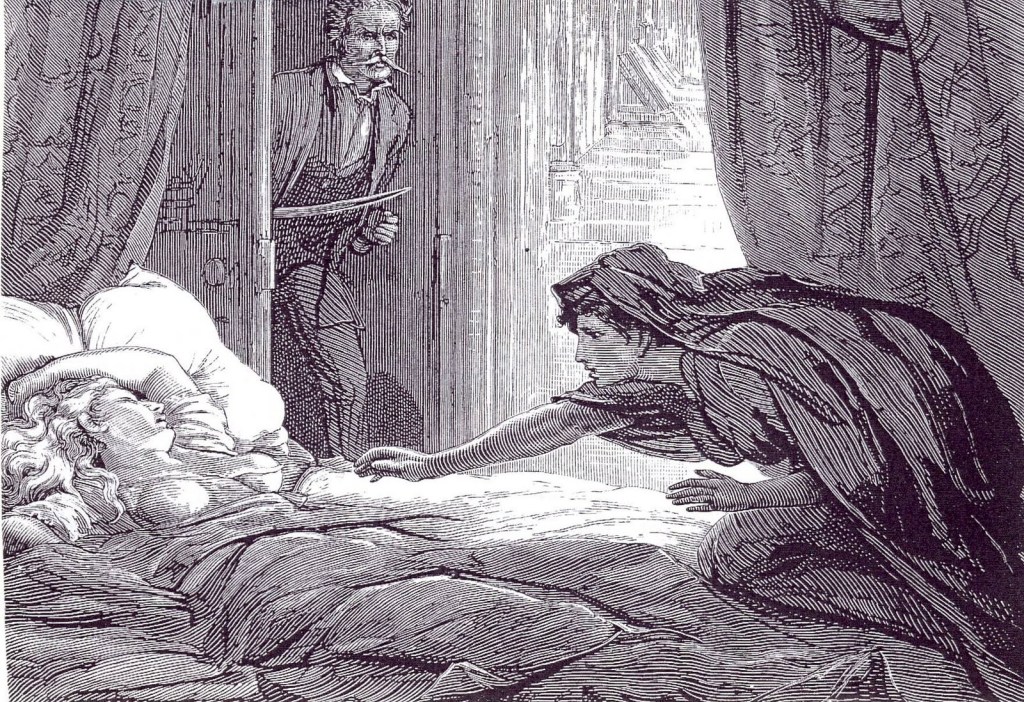
The general plot is fairly simple, though things get pretty weird as the book progresses. Laura and her father live together in an old family castle (from her mother’s side) in Austria. One day, through misadventure, they chance upon another, mysterious young woman, Carmilla, and take her in as a house guest. She is very strange, at once compelling and repulsive. She seems sickly, yet what ails her is unknown. The two young women become enraptured with each other, becoming nearly inseparable and bordering on obsessed. Yet, Laura is frequently upset by the strange behavior and yet stranger statements of mysterious Carmilla. All the while, young women in the area start to die of a mysterious illness.
What I found fascinating about a book, written by a man in 1872, is that the clearly sexual attraction between the two women is not portrayed as unusual or untoward. It is an unhealthy relationship, but not because of its homosexual nature. I could be wrong. I’m not super versed in the social mores of the time. So perhaps there is some puritanical condemnation that I didn’t notice. But there doesn’t seem to be. And while Laura is a somewhat typical first person narrator, in that she spends much of the story explaining what she observed, as opposed to what or how she thought about those things, Le Fanu does write Laura as a thoughtful, if naive woman. She’s not as much of a simpering fool as Victor Frankenstein, or a born victim like Mina Harker (from my memory of both novels, as it’s been thirty plus years since I last read them).
The novel plays out in an odd way, with a few key characters popping in near the ending, first to give the exposition and explanation, and then to do the dirty business of wrapping things up violently. Having read a few other books from the era, I have noticed that the climaxes and finales of some of these stories are not always earned and rely on variations of deus ex machina. This is another to add to the list. The end is very final, but maybe not fully satisfying. Still, I found the book to be enjoyable and occasionally compelling. It’s also short, which isn’t a bad thing. I’ve been contemplating revisiting Dracula, and may have to do that. I’m definitely going to have to read more of Sheridan Le Fanu.
If you like what I do, you can buy me a coffee. Check out my Facebook, Twitter (for now), YouTube, or Goodreads. And take a look at my Patreon page, where I’m working on a novel and developing a tabletop RPG setting. I’m proud to be an affiliate of DriveThru RPG. I’m an independent author. You can also read my fiction over on Amazon. A rating & review would make a world of difference. I now have an Amazon Wishlist.
 Matthew J. Constantine