
In the last decade or two, a resurgence of possibly nostalgia-based love for the halcyon days of tabletop gaming has grown within the hobby. There’s the more and more nebulous “OSR” (Old School Revival, Old School Renaissance, or something else, depending on who you talk to), for example, which seeks to make more perfect versions of Dungeons & Dragons, as well as a lot of games that use more contemporary game design and philosophy to capture the essence of remembered fun. As someone who got my start in the 80s with a different game, and only tried D&D later, much of the OSR excitement is lost on me. Also, I’m on the record. I’ve said it many times. Nostalgia is a trap. The “good old days” weren’t nearly as good as we desperately try to convince ourselves. However, I also don’t want to dismiss the very real fun we remember from our younger years. I say all of that, because RuneHammer’s Index Card RPG, with its notebook-doodle art and energetic enthusiasm seems hell-bent on tapping into our inner child and blasting open the doorways to imagination, while specifically appealing to folks who yearn for those early days playing D&D.
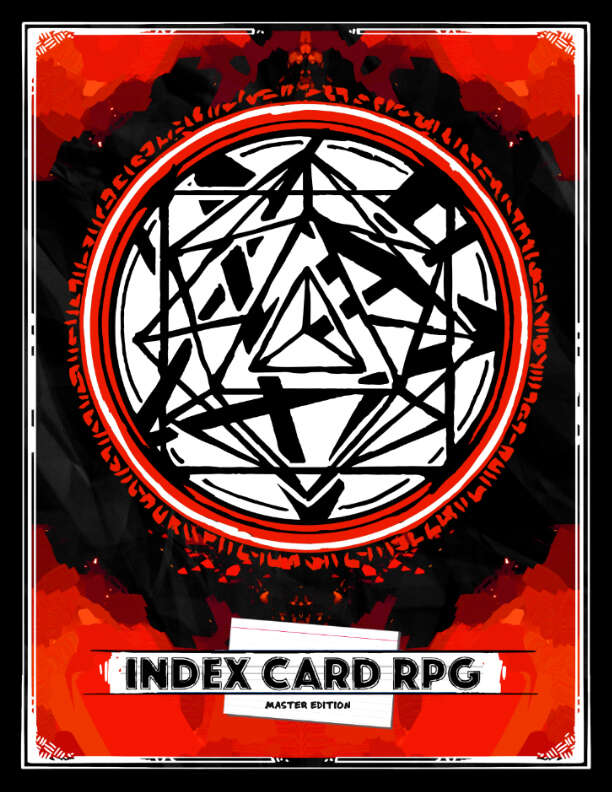
Let me get my concerns and complaints out of the way first. There are multiple versions of this game, and I can’t quite keep track of them. The cover image attached to this review does not reflect the copy I have, which has a solid black background and a flimsy soft cover. I don’t know if it’s been polished more between when my copy was printed and today, as there’s no publication date in the book that I could find. That said, this copy has some editing issues. The first is forgivable for a smaller publishing house, wrong word use. “We’re” instead of “were,” for example. OK. It happens. The other editing issue is one of organization. Going along with the excited glee the author seems to have, the book is organized like a room full of sugar-addled children assembled it. Here are some rules. Here’s some setting info. Here’s some philosophy. Here’s more rules. Here’s some advice. Here’s the section on setting, that references the setting we told you about in a previous chapter but that isn’t here with all the rest of the settings for some reason. Here’s more rules. I’m a simple man. I’d just like the general premise of the game, followed by the basic rules, followed by character creation. Then, if it’s needed, advanced rules, followed by setting info, game master advice, and finally an adventure or two. That’s what I want from a core rulebook for a game I’ve never played. That brings me to my final issue with ICR. Though it’s never explicitly stated and the game has the rules you need to play, there’s a sense that if you’re picking this book up and thinking about running/playing it, you’re already very well versed in and comfortable with Dungeons & Dragons in one form or another. It feels like there are cultural references the author simply assumes you’re familiar with. As someone who has a great deal of tabletop gaming experience, but has played only a limited amount of D&D, I often found myself feeling like the time I took an Intro to Accounting class where the professor assumed everyone had already taken Basic Accounting in high school. This may have been alleviated somewhat had the book been organized in a less haphazard way, but likely still would have posed a problem for this reader.
With all of that said, let me get to the good stuff. The author(s) of this book are clearly super enthusiastic and very much want to facilitate a fun game. They also have an opinion. By that I mean that this game is not designed in an attempt to be all things to all people. It is a game meant to capture a certain vibe. Though very different from Dungeon Crawl Classics, both in rules and style, DCC is the game I kept thinking about. Where Dungeon Crawl Classics is a van with a Frank Frazetta painting on the side, blasting Black Sabbath, Index Card RPG is a dude on a skateboard, wearing an AC-DC band shirt, drinking Mountain Dew. You know they’ve got a lot in common and would probably be good friends, but they also go their own way. ICR has a lot of “old school” ideas in it, but doesn’t feel bogged down in old concepts and isn’t afraid to embrace more contemporary design and concerns. In other words, unlike some of the material coming out of that sphere of the hobby, it doesn’t feel regressive or hostile to modernity.
It is a fast and loose game, with an especially loose grip on the boundaries of genre. Like early D&D, when elements of Science Fiction blended frequently with more traditional Fantasy trappings, echoing the early days of weird fiction, you’re as likely to see a robot as a goblin. In fact, the settings provided, which seem to exist in a semi-connected multiverse, include a mostly Fantasy setting that has an alien threat and refugees from another world, as well as a Space Opera setting, both of which are tightly interlinked. There is also a prehistoric, Ice Age setting and a Weird West setting, both of which are also connected, though more tenuously to the main Fantasy world. There’s a sort of Cyberpunk/Superhero setting that mostly left me scratching my head. But that’s fine. It’s all groovy.
Keeping with the fast and loose style, the mechanics are meant to be pretty simple. Stat plus a die roll VS a target number. Great. Easy. There are some other twists and modifiers, but it boils down to that simple formula. Things like distance, hit points, and such are all simplified when compared to something like D&D 5e. As expected from the game’s name, the index card comes into play in various ways, mostly to keep things organized, accessible, and simple. My concerns with the book’s organization, for example, would probably not be an issue during a game session, as a GM would have all their session notes, rules, NPCs, etc. on a few index cards. At least, that’s how I understand it.
Finally, I wanted to shout out the art, which is such an important part of any tabletop RPG book. It helps, more than almost anything else, to set the mood and tone. The art in this book is black and white, but very evocative. It reminds me of the stuff I’d draw in my notebook when I was bored out of my mind in a high school study hall. Thick black line work. Wild monsters and cool looking characters. A lot of images that make you think and get the creative juices flowing. Good stuff.
I don’t know that Index Card RPG is really for me. There are some concepts, however, I’ll definitely be lifting for my own games and I’m glad I’ve got it on my shelf to draw from and be inspired by. I don’t see myself sitting down and trying to run it for my friends, but if someone was running it at a convention or what have you, I’d love to try it out. That reminds me of one more thing about the game. I’m not saying you can’t play it online, but it very much feels like a game that is best played with everyone in the same room, around a table…or a fire. Folks looking for something less stuffy and stifling than some contemporary games can be, or for a palate cleanser between heavy campaigns, check it out. ICR should be a lot of fun. I appreciate that RuneHammer has an opinion, that they’ve produced a game meant to be run in a certain way, to produce stories of a certain type, with mechanics meant to facilitate that.
If you like what I do, you can buy me a coffee. Check out my Facebook, YouTube, or Goodreads. And take a look at my Patreon page, where I’m working on a novel and developing a tabletop RPG setting. I’m proud to be an affiliate of DriveThru RPG. I’m an independent author. You can also read my fiction over on Amazon. A rating & review would make a world of difference. I now have an Amazon Wishlist.
 Matthew J. Constantine