
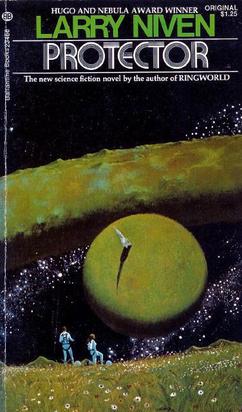
Larry Niven has always been a great idea man. Though sometimes making use of Clarketech (see: Clarke’s 3rd Law), much of his science is at least somewhat plausible, or theoretically possible with the understanding of science at the time, Certainly the ramifications of the tech are plausible, even when the tech itself might be a bit far fetched. Protector has a very wild core concept, and is surrounded by a lot of heady bits of advanced technology.
The first part of the story alternates between an alien on a mission to find a lost colony and a few different humans trying to deal with what appears to be a first contact situation. Niven weaves the characters and their technology and science well. His characters are more characterful than another great idea man, Isaac Asimov, but they’re not really what keeps you reading. It’s the mystery and the ideas. There’s then a time jump, and a new mystery to be solved. That mystery leads to some of the novel’s ultimate revelations.
Niven introduces a very interesting alien species in the Pak. Due to their life cycle, with a third phase that can be very, very long lived, they have a near obsession with their descendants, which makes them profoundly warlike, yet almost completely without malice. They have the ability to be extremely intelligent and inventive, without a particularly deep level of creativity or abstract thought. This allows Niven to explore an inhuman morality, which is cool to look at, and a nice way to sort of balance out his often tech/science focused writing.
As time went on, Niven meshed some separate timelines in his stories into one, creating his Known Space universe, with Ringworld being the most famous entry. This then becomes an early event in the story of Human space exploration and expansion. The first half of the book takes place while Humans have explored and settled a fair amount of the Sol system. By the second half of the novel, Humanity has reached a few other systems and set up colonies there, but this dealing with the Pak is essentially their first contact. Not exactly, as there’s a thing with Martians, but that’s a weird sort of aside (though it is used to explore Pak morality at one point). Whatever the case, the eventual revelations do explore some deep time in the Known Space universe and Humanity’s place in it.
Released in 1973, it is a book of its time in many ways. There are a few bits of the science that haven’t worked out (the 10th planet, for example). But also, it features that weird mix of very progressive ideas about men and women, mixed with some equally regressive ideas on the same subject. If you’ve read Heinlein or watched the original Star Trek, you know what I mean. Alice is a capable, intelligent person, who manages to solve something even a hyper-intelligence can’t. Yet, she’s often presented as little more than an object, often of lust, for the protagonist to “win” or fight for. It’s a weird mix, but one that was fairly common at the time. Change doesn’t come all at once.
I originally read this book probably thirty years ago, and I remember liking it, but didn’t remember much more about it. Well, I still like it, even if it’s maybe not amazing. The ideas are wild and very cool, and that makes it worth checking out if you’re into that sort of thing. I’m planning to dive back into Known Space a bit in the coming months, and it was a nice first step. I wasn’t blown away by it, like I was with my first reading of Ringworld (even more years ago), yet one of the big revelations from this one really stuck with me. I’m curious to see what its ramifications are in the larger Known Space universe, if any.
If you like what I do, you can buy me a coffee. Check out my Facebook, YouTube, or Goodreads. And take a look at my Patreon page, where I’m working on a novel and developing a tabletop RPG setting. I’m proud to be an affiliate of DriveThru RPG. I’m an independent author. You can also read my fiction over on Amazon. A rating & review would make a world of difference. I now have an Amazon Wishlist.
 Matthew J. Constantine