
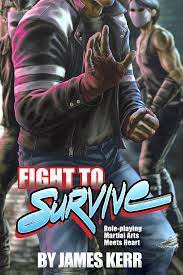
James Kerr from Radio James Games provided me with a review copy of this game. No other compensation was made for me to review it.
I have to admit, I was somewhat dubious of this game when I first unboxed it. A 300+ page rulebook for a tabletop RPG centered on fighting? I believe I’m on record saying that combat is often my least favorite part of most games. Add to that, the game is diceless (nor does it use cards or other instruments of chance). Consider my head quizzically scratched.
Almost immediately, I felt a lot of my trepidation falling away. I am a strong believer in games being “opinionated.” By that, I mean games that have something to say, something to do, and a specific design for going about that thing. D&D, for example, is a game about killing monsters. If you use the rules to tell stories about killing monsters, I suppose they work just fine. People often try to make it about other things, but it typically fails or certainly doesn’t succeed as well as it might if the rules better supported other things. It is, in a sense, an opinionated game that people try to treat as though it is not. Blades in the Dark, on the other hand, is a game about pulling heists in a vaguely Victorian, Fantasy city. The rules are specifically designed for that. Tales from the Loop is a game about capturing a certain brand of nostalgia for being a kid an alternate 1980s, and the rules reflect that. Fight to Survive is a game about the physical, emotional, and even sociological damage that comes from fighting, and the system supports that. There’s a game I’ve heard of but not looked at called Lasers & Feelings, and I kept thinking of that. Like, an alternative title for this game could have been Fists & Feelings.
The author posits a sort of sliding scale of tone for the game, starting with the serious and thoughtfulness of Rocky and moving to the campy, chest-pounding goofiness of Rocky IV. Reading through the book, I was frequently reminded of movies like The Warriors, Streets of Fire, The Karate Kid, and Bloodsport. (This might be a weird one, but I was also thinking about the Step-Up movies, but replace dancing with fighting…or mix the two for crazier results). I also thought a lot about video games like Street Fighter and Double Dragon. Yet, for all the 1980s magic, the game reaches beyond that decade to cover more ground.
The setting is New Hope City. It’s sort of a hodgepodge of New York City, Chicago, L.A., and other large, North American urban centers. It has the various areas and neighborhoods you’d expect, like slums, docks, industrial zones, and the like. There are the requisite disparities between the haves and the have-nots. Immigrant enclaves, gangs, and corporate goons. Another element of the setting, and of the game itself, is the 20th Century. It’s not specifically set in the 1980s, but across the entire 20th Century (I am absolutely loving the idea of fighting Flappers, and have already started thinking about how I’ll add them into my next Call of Cthulhu game). You might begin your game back in the 1910s, and then carry on for decades. Or you might start it in the Swinging 60s, with Hippies and the battle for Equal Rights. As a standard three or four hour play session might take place over one to three years, you could end up covering a large chunk of the century if you played long enough.
I learn by doing, not by reading, and I have not been able to bring this game to the table. I’m not even sure when I might be able to do so. Thus, I’m going to talk about the rules in the vaguest of ways, because I’m not completely sure I understand them or have a proper handle on how they would actually look while gaming. As I understand it, you essentially have a build and some moves (which also have techniques attached to them) which are used in combat. There are no dice, but as in a game like Diplomacy, there’s a sort of conversation or negotiation to find the winner of a conflict. Does your attack go fast enough? Does it hit hard enough? Can you block enough of the attack coming your way? Your build determines when you attack, but moves can do various things to land blows, dodge, or block. While combat is important; the game is called Fight to Survive, after all; it’s really about why you fight and what happens because you fight. Thus, your character has “comforts.” These are the people, places, and/or things that are important to your character, and the things that will make you put your body on the line. They’re what keeps your PC going, keeps you sane, but also what the GM puts under threat to make PCs take action and to spark melodrama.
Tone is clearly important in this game. While there may be temporary triumphs, the ultimate direction is down. Even if your fighter is successful and keeps beating opponents, they are also getting older, and life in the “martial world” breaks everyone eventually. Maybe you aren’t able to stop the gang from burning down your favorite diner. Maybe your mentor’s school is in the way of a new corporate development, and you can’t get the money to help. Maybe you slowed down a bit and that new upstart is able to land a brutal blow. Whatever happens, your fighter will eventually fall. Best case, they retire from fighting and maybe become a trainer. So, like Pendragon, the game is also about legacy. You play your starting fighter until they retire or die, then you make a new PC, ready to throw fists anew. The child of your original fighter? Their student? Something else? That’s between you and the GM. If you do start in the early 1900s and play through the entire 20th Century, you’re likely to have several fighters over that time.
The rulebook for Fight to Survive was a bit overwhelming at first. It feels like there are a lot of rules, a lot of things to keep track of and remember. However, the further in I got, the more it seemed like the book was mostly covering its bases. That’s handy, because it’s a very different game from anything else I’ve seen. There are also copious examples throughout the book, as well as explanatory sidebars. The character sheet isn’t all that crowded and seems to have pretty much everything a player might need on it.
If you’ve got folks who are into the concept of the game and onboard for the play style, this could become a pretty intuitive and smooth system with a bit of practice. I would bet that folks who like stuff like the various Powered by the Apocalypse games would dig what Kerr does here. I would love to play this at a con or something. It’s another game that makes me miss my old gaming crew from the 90s (let me pour one out for those who are no longer with us). Those folks were up for trying whatever game came out. I didn’t know how good I had it.
Check this one out. It’s different. It’s unexpected. With everything that’s gone on in the hobby over the last 12 or 18 months, maybe it’s time for you to try something new. Me? I’m going to go grab my Streets of Fire DVD and remind myself that tonight is what it means to be young.
I recorded a video about it here.
If you like what I do, you can buy me a coffee. Check out my YouTube or Goodreads. And take a look at my Patreon page, where I’m working on a novel and developing a tabletop RPG setting. I’m proud to be an affiliate of DriveThru RPG. I’m an independent author. You can also read my fiction over on Amazon. A rating & review would make a world of difference. I now have an Amazon Wishlist.
 Matthew J. Constantine