
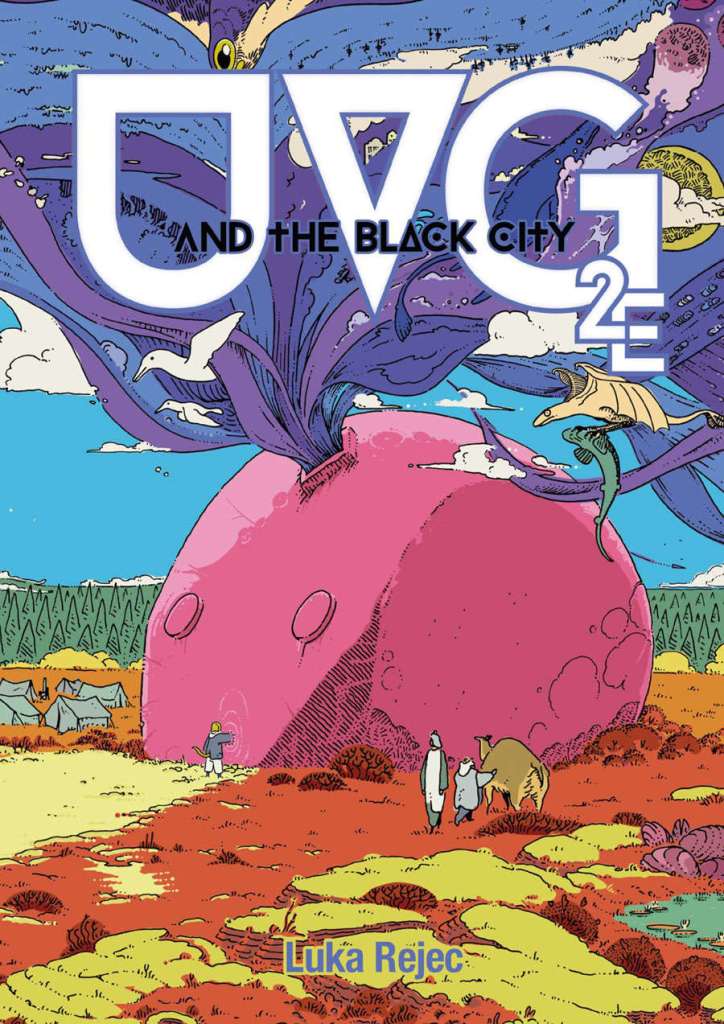
Let me start by saying I have no actual experience with mind altering drugs. Like other substances, I’m not morally opposed to their use, so long as that use doesn’t endanger anyone else. They were just never my thing. However, I do enjoy and respond to a great deal of art that is inspired by or seeks to emulate those chemical induced experiences. From surreal film, to trippy art, to psychedelic music, I generally vibe with some of that drug culture, even though many of those artists (the Beats and the Hippies, for example) seem like exhausting people to be around. Why do I mention this? Because Ultraviolet Grasslands and the Black City certainly evokes feelings of the post-Hippie, drug-dream art and music of the 70s and 80s. It creates a world that looks like Moebius was the set designer, and where you could imagine the music being provided by Blue Oyster Cult or Tangerine Dream. I’m in.
Luka Rejec is the primary creative force behind this, writing, drawing, and designing the book. That certainly gives the whole thing a certain voice. It has a loose game mechanic, based on the general core rules of D&D, but simplified down to a page. I’m not plugged into the scene, but I believe it qualifies, at least somewhat, as part of the so-called OSR movement. That system is mostly there to give you a tool to fold this game into whatever system might be your game of choice. Though it would be easiest to translate to another D20, class/level based system, much of the book is mostly system agnostic, so again, use your game rules of choice. There are extra mechanics presented here that you can graft onto whatever you’re using, like strange careers, magics, and objects. But their presentation is vague enough to let you translate it as you will.
That brings up something important to know about UVG. It’s really not a book made for beginners. I think someone who had no experience with tabletop RPGs would be completely lost if they picked this book up with the thought of using it to run a game. There’s nothing wrong with not being beginner friendly. It’s just important to know that it isn’t. Of course, the chances of some newbie stumbling across this book is also pretty darned small. And when I say all of this, I’m speaking primarily about beginner DMs/GMs/Judges/etc. trying to run the game. Though the game isn’t going to be for everyone, I imagine someone of the right temperament would be A-OK with this setting being the first game they play. Rejec does not hold your hand or tell you how to use any of this material. Very little is explained, even from a structural point of view. Not only are the entries on a given chart fairly vague, by why I might roll on that chart is not always clear. It leaves a LOT up to a GM, giving hints and clues that you’ll only fill out at your table. At some point, there’s a line about the setting defying canon, and that’s very true. Paraphrasing the frequently restated mantra for RuneQuest: Roleplaying in Glorantha, your UVG will vary.
After getting some mechanics out of the way in the first few pages, the book leaps into the setting. In the broadest sense, the game is about traveling from Violet City, across the strange and wondrous Ultraviolet Grasslands, until they reach The Black City. There’s a point-crawl map provided, with keyed locations. Descriptions of those locations and the strangeness that you can explore makes up the majority of the book. Each place has art and several pages of inspirational material.
After the final setting entry, which covers The Black City, the book then switches to what I suppose is the “running the game” section. There are descriptions of caravans and equipment, creatures and spells. Lots of charts to make things weirder. It’s all good stuff, though like the rest of the book, it’s not always clear how you’re meant to use it. Or, perhaps more accurately, it’s here for you to use in whatever way seems best for you and your table.
Over on her YouTube channel, Geek Gamers talked about this book as being a sort of accidental toolbox for solo RPG play. I think she’s right about that. In fact, after reading the book (though I skipped most of the location entries after getting the general sense of how they are presented), I started out on a solo-quest, exploring several locations, trying to make a little bit of money, staying fed, and even making a friend (well, hiring a creepy companion for muscle). For solo play, you’re going to want your favorite rules and oracles and all of that, as well as potentially bringing in some other charts and books to flavor. But there’s a lot of good material in UVG to mine.
While there are many ways you might use the material from the book for other purposes, it would seem that the point crawl journey is the primary intention. It will likely be up to your table to come up with exactly why they wish to travel from the Violet City to the Black City, and along the way, they’ll have plenty of choices as to which direction they’d like to go. It is not a singular, straight path. There are, however, other ways they might explore the setting. Perhaps the Black City does not appeal, and instead, they wish to establish a trade route between The Last Serai and Three Sticks (I don’t honestly know if such a thing would be advisable). How would they do that? That could be what your game is about. Finding a patron, making the journey, making allies, clearing out problems, making enemies, betraying your patron and stealing their stuff, becoming a merchant lord. I don’t know. It’s up to you and your players. You might just enjoy the act of exploring and interacting with things. Maybe a PC is trying to record a certain type of music, or another might be searching for artifacts from a specific lost culture. There are countless reasons for PCs to go in search of adventures, and if not countless, certainly a vast array of ways to use this book to find it. It likely will require some thinking, planning, and improv on the part of the GM, though. Contemplating the idea of running it myself, I expect I’d want to establish ahead of time where the players are planning to go next. So, for example, if they enter a region and spend a day researching what the next location on the trek wants for trade goods, and they decide to get those goods, we can plan on that being the next place they go. So, hopefully, I’d have a week to flesh out that new location, NPCs, possible events and twists, etc., to be ready for the players when they get there. Unless you’re very good at improv and have players who are willing to go along with you, I don’t think this would be the best “out of the book” game. Certainly for my style and ability, I’ll need more time to prepare and make some choices, so I’m more ready to react to what my players might do. I’m not a “seat of the pants” sort of GM. I like to have a firm handle on the situation, the locations, and the characters, so that I can then react to what my players do and how their dice fall. I’m OK with breaking the mold. I just want to know what the shape of the mold is first.
If you are looking for something very strange, something that captures the vibe of Moebius or Philippe Druillet’s comics, with hints of Michael Moorcock and Gene Wolfe’s stranger work, and the soundscapes of Caravan and King Crimson, then this is one to check out.
You can see my first look video here: https://www.youtube.com/watch?v=oaX_gk-OQxg&t=665s
If you like what I do, you can buy me a coffee. Check out my Facebook, YouTube, or Goodreads. And take a look at my Patreon page, where I’m working on a novel and developing a tabletop RPG setting. I’m proud to be an affiliate of DriveThru RPG. I’m an independent author. You can also read my fiction over on Amazon. A rating & review would make a world of difference. I now have an Amazon Wishlist.
 Matthew J. Constantine