
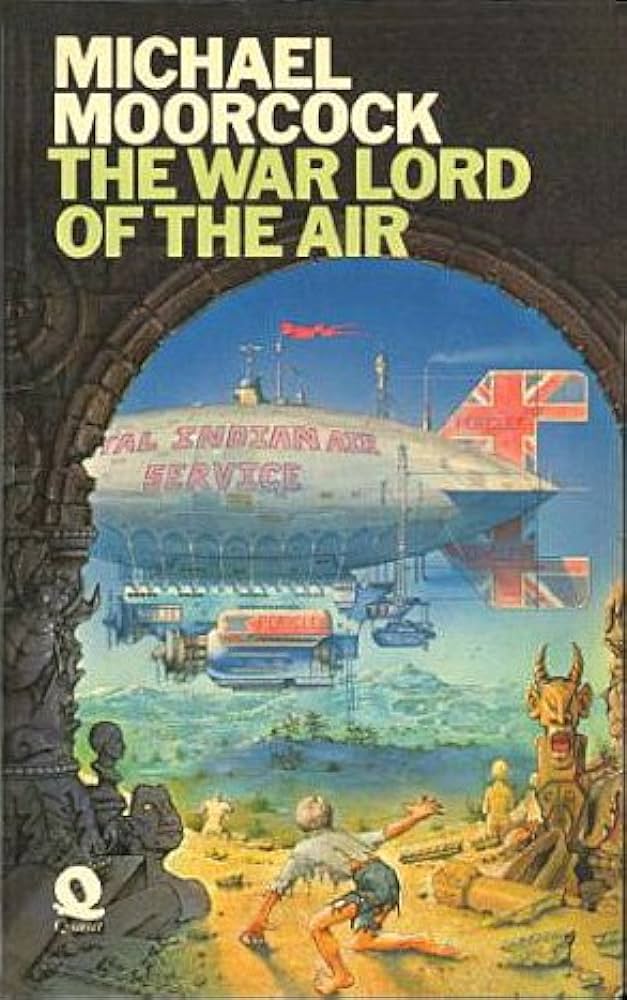
I finally cracked into Volume 4 of Michael Moorcock’s Eternal Champion series published by White Wolf back in the 90s. I haven’t been reading these in order at all, and I’m just going to live with that. Whatever the case, A Nomad of the Time Stream is one I’ve wanted to read since it came out, and I’m glad to be getting to it after all these years. In fact, I had a copy of The Warlord of the Air, the first book in this collection, going back probably a decade further.
I suppose one could make a lot of comparisons between Michael Moorcock and Alan Moore. Bushy bearded British men, who are prolific authors and have produced genre defying and defining works over decades, leaving a major influence on their respective fields. And both, perhaps, a bit high on their own farts. Both men not only catalyzed and expanded on genre for those who came after, but were themselves deeply affected by what came before. I mention that, because the tone and content of The Warlord of the Air reminded me a great deal of Moore’s work, including but not limited to his League of Extraordinary Gentlemen series. Like the latter work, The Warlord of the Air is clearly inspired by a lot of Science Fiction and Boy’s Own adventure stories of the turn of the 20th Century. Both postulate semi-fanciful alternate timelines and populate them with various famous figures, remixed into somewhat satirized versions of themselves. Though Moorcock’s book keeps the focus mostly on real life figures for his new takes, the overall feel is similar.
There are dashes of Edgar Rice Burroughs, H.G. Wells, Jules Verne, and even a bit of Philip Francis Nolan’s Armageddon 2419 AD (the original Buck Rogers story) in the way things all kick off. You can sense attempts to both satirize and moralize on Empire, colonialism, utopianism, racism, and more, though I’m not sure it really works. Per Moorcock, the books were at least partially inspired by the works of E. Nesbit, whose works I have not read, though I’ve seen adaptations of her book The Railway Children.
The general plot finds our not especially compelling lead, Captain Oswald Bastable (a name taken from Nesbit’s novel The Treasure Seekers) getting knocked out in the 1910s, only to be awakened in a very unusual 1970s. It’s a 1970s where the colonial dreams of the various super powers did not wither and die, but conquered the world, creating a semi-peaceful and somewhat Utopian new world of airships and prosperity. Yet, there are malcontents, seemingly bent on chaos and nihilism. Of course, things aren’t quite what they seem.
I’m not well versed enough in certain elements of Moorcock’s Eternal Champion mythology to know what things might mean, but a character with the surname Von Bek shows up, as does the character Una Persson. Von Bek has been the surname of at least two other incarnations of the Eternal Champion, but this time around, that character doesn’t seem to be one. Or maybe he is, but we’re not seeing his story. And Una Persson is, if I remember correctly, Jerry Cornelious’s sister, some sort of swinging 60s super spy, though again, in this book, she doesn’t end up doing much. In fact, Von Bek and Persson are set up as though they’re going to be major players, but never really figure much into what’s happening. I wonder if they were added in during a later re-write, as I know Moorcock revisited this book before its publication by White Wolf, as he did with many. I’m sure, for example, that the addition of our alternate Ronald Reagan as a sputtering and inept Boy Scout surrogate troupe leader was a late addition, as there would have been little reason to include him in 1971 when the novel was originally written, unless Moorcock was particularly interested in who the governor of California was at the time.
On the one hand, I love weird alternate history twists, and of course, airships and whatnot. This trilogy is considered an influence on what would become the Steampunk subgenre. On the other hand, the book often feels like Moorcock is trying to make a point, but I’m not sure he ever really does. Or worse, if he does, that point might just be, “meh,” the ultimate philosophical dead-end embraced by Generation X. And, to paraphrase some hipsters of a decade ago, “you can miss me with that.” If it’s a message book, which I think it is, either I’m not clever enough to get it, or (and I think this is closer to the truth) Moorcock felt himself so clever, that the message is muddled past the point of being especially useful or interesting.
If you like what I do, you can buy me a coffee. Check out my Facebook, YouTube, or Goodreads. And take a look at my Patreon page, where I’m working on a novel and developing a tabletop RPG setting. I’m proud to be an affiliate of DriveThru RPG. I’m an independent author. You can also read my fiction over on Amazon. A rating & review would make a world of difference. I now have an Amazon Wishlist.
 Matthew J. Constantine