
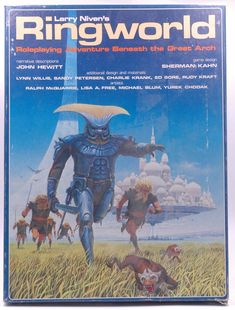
Based on Larry Niven’s award winning novel Ringworld, and the future history it shares with several other of the author’s works, this 1984 boxed set from Chaosium has been a Holy Grail of gaming for me for decades. Thanks to my friend Michael, I now have a copy and I’ve been able to read it. The boxed set includes four books, the Explorer Book, Technology Book, Creature Book, and Gamemaster Book. It also has some reference sheets and a sheet of character silhouette, cardstock standees. I believe it originally had dice, but they’re long since lost to time. And that’s fine, as dice in 1984 weren’t always of the best quality.
John Hewitt was the writer on this one, with Sherman Kahn on “game design.” Like a lot of Chaosium books from the time, this feels both “of its time” and “ahead of its time.” In a lot of ways, the hobby is still trying to catch up with what Lynn Willis, Greg Stafford, Sandy Petersen, and the rest were doing way back when. However, there are definitely elements that are clunky, in part because this was still the Wild West era of RPG design. What we’re left with is pretty awesome, but also in dire need of a reworked second edition, which sadly will almost certainly never happen.
In Ringworld: Roleplaying Adventure Beneath the Great Arch, player characters (PCs) are called Explorers. As the title indicates, the Explorer Book is for them. This book covers character creation, the basic breakdown of Known Space, the greater setting of Larry Niven’s books, within which his Ringworld novels are set. There is a quick history, a brief guide to several key Human settled worlds, write-ups on the major alien factions, and a fairly extensive glossary of Known Space terms. The core Basic Roleplaying mechanics are explained, with a few twists unique to this game. I think this is the only BRP game to dive deep into having skills surpass 100%, but when you’ve got PCs who are living into the hundreds of years, I guess it makes sense that they would have some skills beyond what a normal contemporary person could have. As is the case in many games of this time, the rules, though mostly intuitive, are explained in a way that makes them feel a bit more technical and difficult than they really are. If I were going to run Ringworld, I’d almost certainly do it with the new edition of Basic Roleplaying, so it probably wouldn’t matter anyway.
The Technology Book is exactly what you’d expect. There’s a general discussion of where Human technology is at the time of Ringworld exploration, as well as various bits of alien technology and ultra-tech. Due to the specifics of the setting, you’ve got some super ancient, but ultra-powerful items. You have some weird stuff. And you have a lot of the expected, mostly “hard” Science Fiction technology. Like a lot of Science Fiction of the day, the future of computers didn’t turn out quite the same, but it wouldn’t take a ton of work to adjust that if you were so inclined. Overall, there’s enough stuff in here to keep players happy for a while, and enough variety to let a GM design more when the need presents itself.
As you might expect, the Creature Book covers the various denizens of the Ringworld as well as some of the other major aliens (who may or may not be on the Ringworld somewhere). One of the really interesting things about the Ringworld is that, due to some of its deep time history, many of the creatures are actually descendants of early Humans, or are related to them, but they’re filling biological niches where we might not expect to find hominids.
In the Gamemaster Book, we get the meat of the setting and lots of “truth” behind the mysteries. This book in particular, is crammed full of inspirational material. Much of it is just that, inspirational. There are a lot of ideas and seeds of ideas, but it is left to the GM and their players to flesh things out and make the world more expansive and developed. In keeping with Greg Stafford’s old “your Glorantha may vary” philosophy of game design, a lot of the canvas is left blank so that your Ringworld will vary from any other game played on its surface. As an experienced GM with a long history of creating his own adventures and stories, I like a lot about this approach. However, I can imagine a new GM would be a bit lost. If this were made today, I imagine it would be presented as much more of a “toolbox” with slightly more fleshed out ideas, plenty of random charts, and maybe a bit more structure and suggestion for what to actually do. I’m not necessarily saying one way is right and the other wrong, but I imagine this game would be daunting if it were your first foray into the hobby. There is also an adventure, The Journey of the Catseye, which I think goes a fair distance to helping a potential GM get an idea of things, but I think it could be better. The adventure itself is fine. I’d probably trim off the first chunk of it, and start things with the crash, but otherwise, I think it’s pretty good. However, I would love to have seen something more extensive, with more encounters. Maybe something like that ended up in the Ringworld Companion. I don’t know. I haven’t been willing to drop collector prices on that. It recently sold on eBay for $130. and that’s just silly.
I have a lot of thoughts and a lot of feelings about this game, and I doubt I’ll get a fraction into this review. With some work, this boxed set contains material that could be the foundation of years of play. I came away from reading it with a head overfull of ideas for characters, creatures, individual adventures, and sprawling campaigns. Known Space overall is a pretty cool setting for a slightly more Traveller-esque Science Fiction game, but the Ringworld presents so many wonderful possibilities. Combine this with some more recent Science Fiction RPG toolkits that are out there and you could really create some wonder.
That said, it isn’t always the easiest to read or to parse out. I didn’t feel like the explanation of the rules was especially good. And a lot is left to potential GMs and players to figure out. This was true of many games of the era. I wouldn’t call a lot of RPG writing from the 70s and 80s “user friendly.”
My biggest complaints come down to presentation. The layout is brutal. Again, I know it was closer to the industry standard of the time. But you’re often forced to look at page after page after page of three-column text walls. Sections start at the bottom of one page and jump to the next. Breakout boxes seem to have been tossed in at random sometimes. The Creature Book probably features some of the worst examples of this, but it’s true throughout. I’m not saying it has to be the Ben Milton/Questing Beast two-page-spread for everything, but this is rough. And the artwork, or lack thereof. I like the black & white line art of this era, and the stuff in this book by Lisa A. Free is pretty good. There simply needed to be a lot more. A lot more. Not only would it have helped break up the walls of text, but particularly in the Creature Book, I needed some visuals.
There are roughly 180 pages spread across the four books. If you didn’t change a word, but reformatted those pages to conform with contemporary industry standards in layout, font, and art, you’d be looking at a book of at least 500 pages. I, for one, would love to see that. However, I realize that doing a second edition, no matter how much it is needed, is likely not a financially sound idea. Larry Niven’s work is not particularly popular any longer. Science Fiction has traditionally been a somewhat hard sell in the tabletop RPG sphere, where 99% of the oxygen in the room is taken by Dungeons & Dragons and its many variations (heck, probably 75% of the indie scene is OSR-type stuff, which is just D&D with the serial numbers filed off). I’m sure there are rights issues to contend with. The fact that Niven’s work hasn’t been adapted to film, and I don’t even think has made it to the comic book sphere, means there’s not much recognition out there in the cultural zeitgeist. So, hiring artists, graphic designers, game designers, writers, and editors to revamp a 40 year old RPG that I don’t think sold very well the first time, when Niven and Ringworld were still popular, doesn’t seem like a good idea. But gosh, I wish it would happen. Especially now that Basic Roleplaying has a new, open license thingy for its mechanics. Honestly, I’d be happy with a nice “Visual Guide to Known Space” art book. But I don’t see that being a hit either.
Anyway, I’m very happy to finally have this game in my grubby little hands. I suppose the proper way to thank my friend for making it happen would be to organize a game for him to play in, but I’m not sure when that’s going to happen. This could definitely be a wonderful rabbit hole to fall into. Again, there is simply no end to the amount of stuff you could do with this game. There’s almost a choice overload going on. I think that’s why I’d love to see a really fleshed out adventure. Not because I’d want to run it necessarily, but because seeing a framework or scaffolding might help crystallize some patterns in my own head and let me focus on something. The setting as presented in this game is almost too big, too open.
Here’s a YouTube video I did about the game.
If you like what I do, you can buy me a coffee. Check out my Facebook, YouTube, or Goodreads. And take a look at my Patreon page, where I’m working on a novel and developing a tabletop RPG setting. I’m proud to be an affiliate of DriveThru RPG. I’m an independent author. You can also read my fiction over on Amazon. A rating & review would make a world of difference. I now have an Amazon Wishlist.
 Matthew J. Constantine