
If you’re not new here, you know the refrain. “I’m not a D&D guy, but…”
My other refrain is “Dungeon Crawl Classics is like someone looked at D&D and thought, ‘what if this was actually fun?’” Well, ShadowDark is like that, but much, much, much more stripped down. Where DCC is everything and the kitchen sink, ShadowDark is lean and mean.
I really had no interest in this game, or any intention of acquiring it for quite some time, as it seemed like it was meant mostly as a bridge between two places I didn’t want to be, D&D (specifically 5e) and the so-called OSR. Having never enjoyed playing D&D, I swore it off completely back around 2001 or 2002. I kinda got tricked into playing some version (D20 Modern, I think) at one point, and then allowed myself to get talked into playing 5e a couple times in the last few years, and it reminded me just how much I’ve never enjoyed D&D. And the OSR (Old School Revival/Renaissance/several other words that start with “R”)? It seems like so much navel gazing, retconning, and false nostalgia as far as I’m concerned. I’ve seen so many people who weren’t alive when I started gaming (and I didn’t start until the latter half of the 1980s) who confidently talk about how “they used to play.” No we didn’t. Not all of us. Probably not most of us. Is that how Gary Gygax and Dave Arneson played? Maybe. I don’t know. But who cares? I was never at their table. But I can promise you, no table I ever sat at played anything like anything I’ve ever heard talked about as “OSR.” And other than a couple super-poindexters who used to be regulars at the game shop where I spent most of my life in the 90s, nobody I’ve ever talked to about tabletop RPGs, including folks who were there from the birth of the hobby, played like these “experts” assure me “they used to play.”
So, why would I pick up this bridge between two things I don’t like? Well, the more I learned about it, the more it reminded me of Dungeon Crawl Classics. I don’t know where the magic of DCC comes in, but somewhere in the fiddly bits, they made a version of D&D’s core concept that somehow comes out fun and functional. And unlike every other version I’ve tried, it didn’t feel like the rules were constantly getting in the way, constantly sabotaging the table’s enjoyment. Part of it might be the magic system. D&D’s supposed “Vancian” magic just sucks. That’s not an opinion. That’s science. Look it up. Not the least of which is, it doesn’t really work in that classic Jack Vance way. It isn’t just that the spell leaves the mind when it’s cast. It’s that the spell comes to life and escapes into the world. There should be consequences beyond the momentary flash of fire or what have you. But it’s more than that. I’ve spoken of DCC as being a 3rd Person game. With many games I’ve played over the years, part of the fun of the game is “inhabiting” the character you play, thinking about the world through their eyes, and reacting in ways that make sense through their understanding of events. I don’t have that feeling when I play or run DCC. Instead, it’s more like when I’ve played games like Paranoia. Like I’m watching the life (and gruesome death) of a character. Sure, I make choices and direct them to do things, but half the fun is seeing what amazing things they get up to, and then what horrible fate awaits them. I may occasionally imagine what they might be thinking, but more in the way I would a movie or video game character. Ultimately, I’m watching what they get up to, not trying to imagine being them for a time.
ShadowDark captures a lot of that DCC vibe, as far as I can tell. Intentional or not, I’m not sure. I know that author Kelsey Dionne has cited DCC as one of her inspirations, especially when it comes to ShadowDark’s gauntlet adventures, which are analogous to DCC’s funnels, where each player takes control of several peasant characters and runs them through a dangerous situation. Whoever comes out on the other side can graduate to an actual 1st level character with a class and whatnot. I don’t know if ShadowDark is meant to be thought of as 3rd Person. I’m not sure if anyone is really thinking about games as 1st Person and 3rd Person, of if that’s just a me thing. But, as I read through the rules, I certainly felt that would be the way I’d approach it. The game seems swingy, a bit chaotic, and deadly, like Dungeon Crawl Classics. And you don’t want to get too attached to or invested in any one character in a game where death isn’t just possible, but likely. Mike Shea of Sly Fourish talked about his ShadowDark campaign where I believe one player went through something like seven characters over their year of playing.
With ShadowDark, we have the D&D core mechanic boiled down to its basics, and with much of the convoluted math removed or flattened. To paraphrase or reference Quinns Quest, this doesn’t have a character sheet that makes you feel like you’re doing a wizard’s taxes. The familiar D&D stats. Some bonuses derived from them. Roll a 20 sided die and add any bonuses, trying to beat a target number. For example, a sea serpent might have an AC (the target number) of 14. I want to hit it with a hammer, which uses my Strength bonus, which is a +1, so I need to roll a 13 or higher on a 20 sided die (13+1 is 14; a hit). Then I roll some damage and Bob’s your uncle. There are a few more “modern” things like luck tokens (actually been around for a long time) and advantage/disadvantage (also not actually new). Luck tokens are a “meta currency” that are awarded for certain reasons, and can be spent to adjust some numbers in your favor. While advantage and disadvantage have you roll an extra D20 and take the higher or lower number, respectively. This is meant to simulate you being in a better or worse position to take an action. So, if it’s the middle of a hurricane, you might have disadvantage on shooting an arrow at a target. That’s most of the mechanics. You don’t get many hit points, so you’re never playing the kind of character that can be peppered with arrows and keep going like nothing’s happened. Wizards have to roll to see if their spells go off (like DCC) and only “forget” the spell if they fail. Also, and this is a small change but makes a big difference, spells have tiers, not levels. The amount of confusion that having a 10th level wizard with a 5th level spell created. Just don’t use the same word when they don’t mean the same thing in context, people. It’s not hard! Finally, there’s the much discussed “real time” torch mechanic, which seems mostly to be a tempest in a teacup. When you’re dungeon crawling (or anywhere where it’s dark) you have to use a torch or lantern to light your way, and those things last for one hour of real time. It’s just a ticking clock to keep players from lollygagging or getting too off topic. It’s fine. Is it gamist? Yes. But then, this is a game.
The core book doesn’t have a specific setting, though it has a specific tone. The Arcane Library is developing a setting through the Cursed Scroll zines. That setting is pretty standard “Fantasy Land” stuff. The tone is a bit darker, a bit harsher. But that’s in keeping with the mechanics, where death is a constant companion. It’s not meant to be a Fantasy super heroes game, like 5e. By their nature, level-based games have an issue with power creep. ShadowDark tries to counteract that by flattening the math and limiting characters to 10 levels. Does it work? Ask me if I ever run a game that goes on long enough for characters to reach level 10.
If I have one knock on ShadowDark, it’s one that is shared with many genre settings, and that is the struggle of Law and Chaos. I’ve never liked alignment. Thought it was silly when I first heard about it back in the 80s. It never really featured in any of the games I was into, until DCC, I think. And in DCC, like ShadowDark, it’s a simple spectrum. Law, Neutrality, and Chaos. No attempts at morality policing with Good and Evil. However, like with the Warhammer universe, Chaos really is just another name for Evil, and that bugs the crap out of me. I’m a big fan of Moorcock’s Eternal Champion series, and that’s the way I’ve always taken the conflict between Law and Chaos. Too much of either is evil. Balance is the ideal. But Chaos by itself, and Order by itself is neither good nor evil. It only becomes evil in its extreme. Nazi Germany and Stalinist Russia could be seen as Law taken too far. Open warfare, violent revolution (even a justified one), or a natural disaster might be Chaos in its extreme. Anyway, that’s a me thing. I don’t like Chaos being a synonym for Evil. Obviously, I own the game now, so at my table, it won’t be. It’s just a sort of pet peeve of mine that goes beyond the tabletop gaming industry.
If I had a second knock, it’s that there’s no sample adventure in the basic book. That said, I believe there’s more than one available to download free of charge. Not ideal (who knows what the state of any given website or the internet as a whole will be in six months or thirty years?).
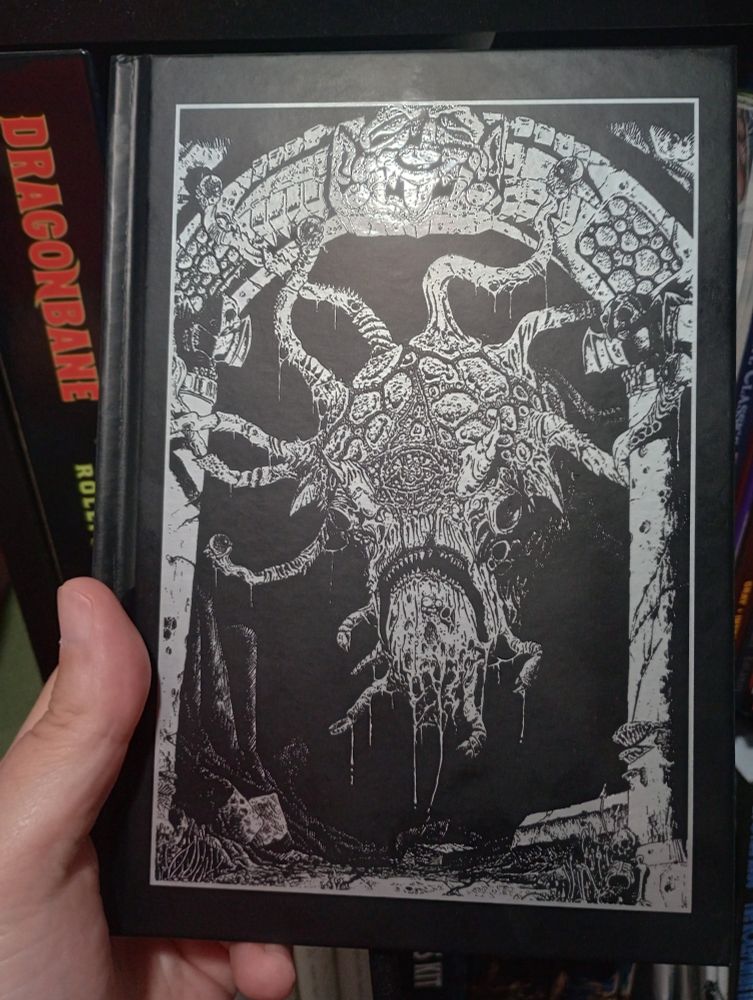
One of the things this book is singled out for is its layout, and I must admit, Dionne’s design and layout are top tier, and I think really made for the GM. On first pass, I am a bit annoyed by a lack of index, as I am a firm believer in the use of a comprehensive index, especially in the case of roleplaying books. However, the table of contents is rather detailed, and the book is laid out in such a way that most things should be fairly easy to find with just that. Most subjects are covered in one or two page spreads, with large print and bullet points. I’ve seen some complain that this means there’s a lot of wasted space. And I understand. Absolutely, this book could have been condensed fairly easily into something half its page count. However, I think the utility of the pages wins out in this case. The book isn’t cheap, but there are also a lot of cheaper (cheap as free) options for starting play. The art is nice, too. It’s fairly uniform in theme, if not in style. Heavy black & white stuff, with lots of nasty monsters and creeping rogues. Like the art in DCC, it’s very evocative of a certain style and harkens back to a certain time.
If it’s not obvious, I really enjoyed reading this, and I’m looking forward to bringing it to my table. Where DCC is “D&D, but fun,” I think ShadowDark is “DCC, but easy.” I’ve seen some complain that it’s not good for longer campaigns, and I don’t really think that’s the case. While it’s true that it might not be great for what seems to be the typical contemporary 5e game, where characters pretty much can’t die, folks have multi-page back stories, and it is intended that the campaign will be a grand epic with multiple subplots that weave into each PC’s backstory, if you approach it for what it is, it should be plenty workable for a long form game. Look less for complex explorations of theme and motive, and more emergent story that comes from players interacting with the world. Think less about “my character’s story,” and maybe more “our adventuring band’s story.” If you’re looking for ultra-detailed character builds where fussing over the numbers and the interactions of this power and that, and if only I could get to 6th level where I can finally unlock X…well, no. This isn’t going to be good for that. It’s not that kind of game. That’s not good or bad. It’s just different. Folks often complain about DCC in the same way, but I’ve managed to run two games that went on for many seasons. Both ended because of life (and death) issues, not any failing on the part of the game. Maybe one of the best things about it, as far as I’m concerned, is that the system is simple enough that not only CAN you run combat theater of the mind, there doesn’t seem to be much of any reason to run it on a grid, whereas, I can’t imagine a combat in 5e working theater of the mind, especially not when the characters reach mid-high levels. It’s meant to be tactical combat, with lots and lots of noodly bits where the various mechanics interact and things like the exact position of a character related to another is not just important, it’s necessary. That’s not ShadowDark. And that’s OK. Better than OK for this old theater of the mind veteran (I think I’ve only used miniatures in my games maybe three or four times in almost 40 years).
This is close enough to D&D that folks who “only play D&D” won’t be lost. But it’s also far enough away in just the right ways, that this guy who will “not play D&D again” might still enjoy playing or running it. In fact, I’m kicking around running it for some folks who want to “play D&D” because of the cultural significance and pop references. I think I could run this for them and we’d all be happy. I’m also hoping to use ShadowDark to run through a bunch of classic D&D modules and campaigns at some point. But I’m going to try not to get too far ahead of myself.
Check out my unboxing of ShadowDark here.
I’m an independent author, so… If you like what I do, you can buy me a coffee. Check out my YouTube, and/or take a look at my Patreon page, where I’m working on a novel and developing a tabletop RPG setting. I’m also proud to be an affiliate of DriveThru RPG.
 Matthew J. Constantine