
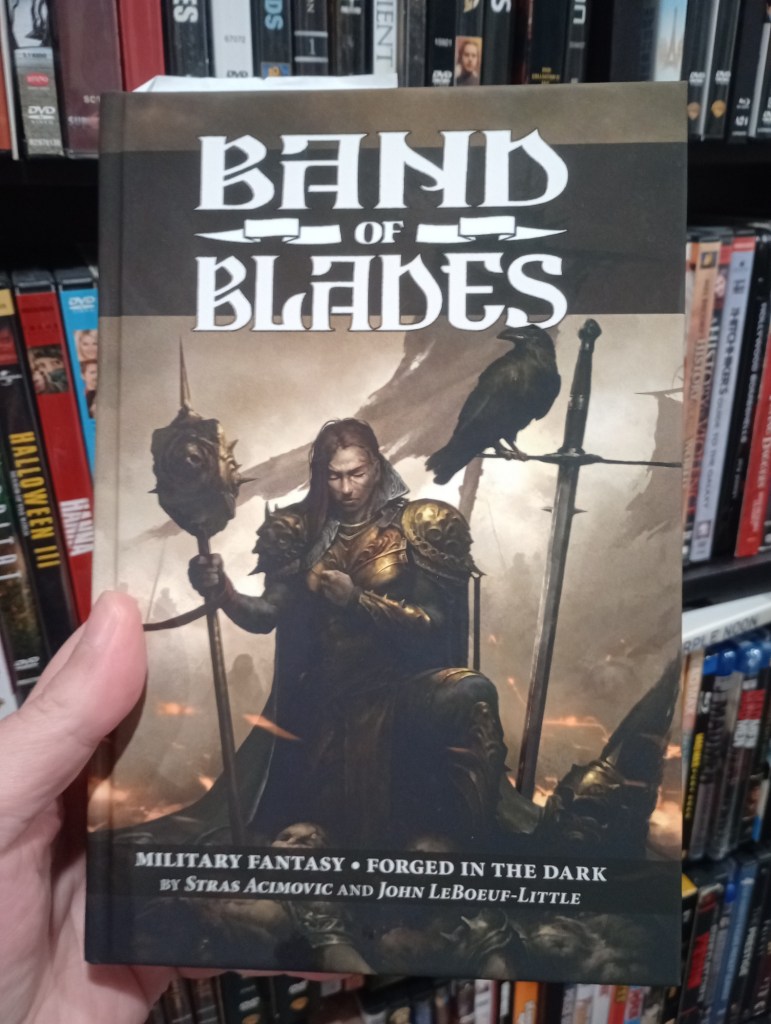
Sometimes I read a roleplaying game’s rule book and come away wishing I could assemble a group of people later today and start running a game for them. Other times, I read one and think, “this is not for me.” Once in a great while, I read one like Band of Blades, where I simply can’t imagine actually running the game, but darn it, I’d love to play in it.
Stras Acimovic and John LeBoeuf-Little have used the Forged in the Dark rules system, as seen in the very popular Blades in the Dark, to create a Dark Fantasy, military game with strong The Black Company vibes. I know I’ve said in the past that I like “opinionated” games, and this definitely qualifies. This isn’t a game meant to tell any of a dozen general Fantasy tales, or to have players take on whatever roles they feel like. The game is meant to create a certain style and tone, and to flow in a certain way. It isn’t a so-called railroad. There will be a lot of player choices, and a lot of variation between campaigns. But all that choice and variation will be within a limited context, and I think that’s rad.
What is that context? Well, in classic Dark Fantasy form, an evil Dark Lord (™) called The Cinder King, has arisen, created an army of the undead, and launched a crusade against the living. The gods sent their Chosen out to help the living peoples stand up against this evil force. It all culminated at the Battle of the Ettenmark Fields. Humanity lost. The game picks up in the aftermath of that fateful battle as the Legion, a storied band of elite mercenaries, is fleeing the oncoming hoards of undead, trying to make it to Skydagger Keep for one last stand. Normally, with a tabletop roleplaying game, there is no “winning” or “losing.” Did you have a good time? Did you create a cool story? Great. Everybody wins. But with Band of Blades, you are trying to achieve something specific, and there’s a good chance you’ll fail. There’s actually a final scoring system to see how well your group does. Not something you tend to see outside of old D&D tournament modules. Part of the previously mentioned limited context is that this game is meant to have a specific beginning and a definite ending. It starts with the Legion in a certain place. It ends, either with the Legion being caught and destroyed by the forces of the Cinder King, or with the remnants of the Legion reaching Skydagger Keep, where they will have a chance to hold the line against the undead, or fall into darkness.
This is all meant to take place over what I assume would be ten to twelve sessions. Though you could, theoretically, continue the game after a possible victory, the book does not really give you much help on how to do that. It seems to me that your game is over at that point. Move on to something new, or try again with different choices. I could definitely see this game having replayability, as there are a lot of choices along the way that would make the campaign play out in wildly different ways. But I don’t think it’s something I’d want to play twice “back to back.” Like, I’d want to try something else, something with a lighter tone, perhaps, after going through a campaign of this, as I think a well run campaign would likely involve a persistent sense of grueling dread, bordering on hopelessness.
I haven’t spent a lot of time on the various message boards and servers where a lot of the experimentation and theory of tabletop roleplaying games developed over the last thirty or so years. So, I don’t really know the ins and outs of various systems and lines of mechanical thought. From what I understand, a game called Apocalypse World came out and made some small waves in the indie scene. Some folks took ideas explored in that game and made Dungeon World, and Dungeon World broke containment, becoming indie-popular in the 2010s. The so-called Powered by the Apocalypse rules became very influential, with lots and lots of new indie games taking pages from Apocalypse World and Dungeon World. One of those influenced by PbtA was John Harper, who created Blades in the Dark, a Dark Fantasy, urban, heist-themed game that became an indie darling, using the Forged in the Dark rules, which were a heavily modified descendant of PbtA. Suddenly, a lot of Forged in the Dark games started coming out. I’m not sure every game that came along was really a good fit for either of those systems. But some, like this one, I think work really well with it. All that said, I don’t think PbtA or FitD are really systems that fit my GMing style. In fact, Thirsty Sword Lesbians was the first time I read a game from this overall family of game theory, where I felt like I actually understood how things would work at the table. The author of that game wrote rules in a way that actually clicked with how my brain functions. That’s the thing with opinionated games. They’re not trying to be for everyone, and that’s OK. More than OK. That’s great. While I absolutely would love to try playing pretty much any of the games I’ve read, including Band of Blades, there are just a lot of things about the mechanics that don’t function the way my brain does, at least in relation to the cat-herding that is GMing. Maybe I’m wrong. Maybe if I played it for a while I’d start to feel comfortable with the idea of running it. I don’t know. As is? No.
There’s a tone and vibe to Band of Blades that I really like. While it doesn’t use any names, nor does it recreate any specific plot elements that I know of, it’s clear that Glen Cook’s The Black Company was a major inspiration for the world and for the Legion your player characters belong to. (As far as plot structure, it’s more like the 2004 Battlestar Galactica series). The big evil lord, his colorful and ultra-powerful lieutenants, your army’s almost saintly Chosen, all juxtaposed with the meathook reality of a grueling march across a dying land, facing off against a relentless foe. Very The Black Company. Though Cook’s novels had a distinctly Vietnam War aspect, Band of Blades kept making me think of World War I. Whatever the case, I found a lot of inspirational ideas contained in the book. And I’ve already lifted several things for the armies of the undead in my hypothetical ShadowDark/Dungeon Crawl Classics sandbox campaign I keep picking away at.
It may not be for me, at least as a GM. But it’s going to be for someone. Now, will someone in my area run it and invite me to play? That’s the real question.
See my first look video here: https://www.youtube.com/watch?v=nLSokluCLSo
I’m an independent author, so… If you like what I do, you can buy me a coffee. Check out my YouTube, and/or take a look at my Patreon page, where I’m working on a novel and developing a tabletop RPG setting. I’m also proud to be an affiliate of DriveThru RPG.
 Matthew J. Constantine