
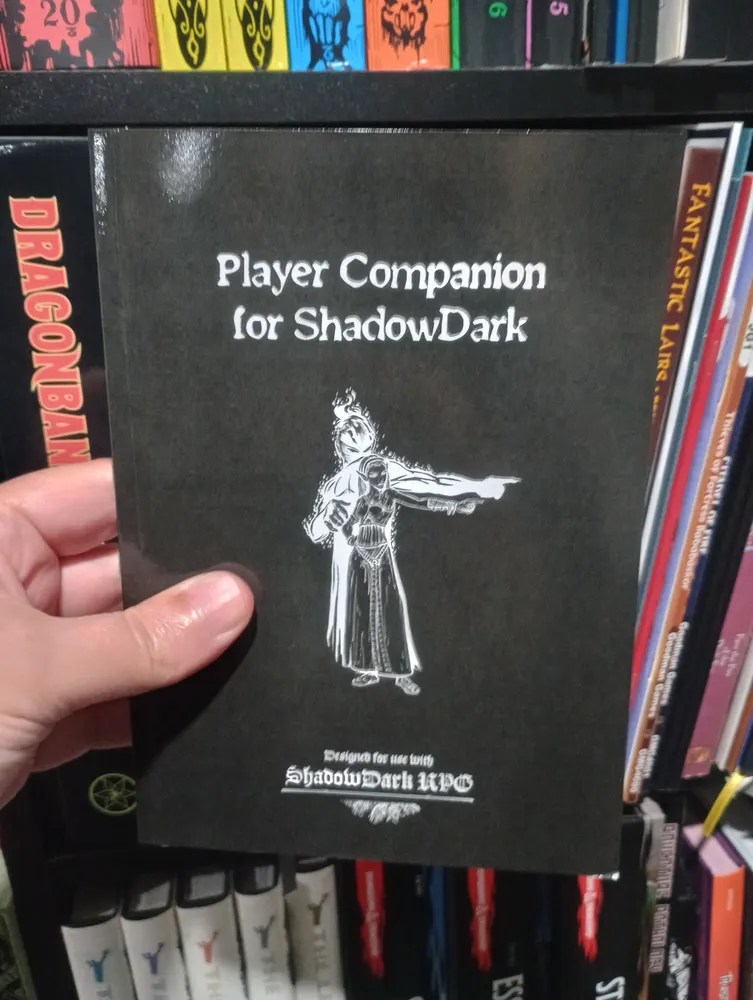
Last year’s “new thing” for me was ShadowDark, and I’ve since picked up several books and zines for it. The game does much of what I liked about Dungeon Crawl Classics, but in a simpler way, which appeals to my rather simple mind. Thanks to the game’s creator, there’s also quite the DIY, fan-made community out there. One prolific creator of ShadowDark material is The Chubby Funster, aka Greg Christopher. With this book, he’s provided a lot of extra options for player characters. One could argue that the point of ShadowDark is not having too many options, but there are some cool ideas here that could add fun to your game.
First up is a chart with a new selection of backgrounds. I suppose if you’re tired of the ones from the basic book, you can roll on this chart. Or, you could roll a D2 (coin flip, or even/odd roll, etc.) to choose which chart to roll on. Then we’ve got one of the sections that seems to cause the most controversy, new ancestries. Without actually having any of these at my table, I can’t say for sure, but nothing about anything here seems outside the bounds of ShadowDark’s core ethos. Do I need like five variations on the Elf? Or three different types of Gnome? Not really. However, I can see picking and choosing some to plug into your game, depending on what flavor you’re looking for. Heck, maybe you want to do an all Dwarf game, and want players to have some core variation between them. I still have to design my own ancestry at some point, because my DCC/ShadowDark world has playable rat-folk, and I haven’t seen anyone tackle those yet.
Then we’ve got new classes. Thirty six new classes. Zoinks! As with the ancestries, several of these seem to be slight variations on a theme. But also like with the ancestries, I could easily see a GM picking and choosing which ones to offer to players. I’ve been kicking around using the video game “souls-like” concept with a campaign, where only by achieving certain goals, like certain levels, do players “unlock” new classes. So, someone might need to get a character to level 3 before that character gets killed, to unlock the Ranger class, among a few others. So, at that point, if their current character dies, they could start a new level 1 character with the Ranger class. I can then sort of control what classes are around by putting them behind various achievement walls. Alternatively, it might be nice to have a bunch of situationally/environmentally appropriate classes. If I were running an urban game, for example, I might like to have the Assassin, Brigand, Burglar, and Charlatan among others, available. I know there are folks out there who believe anything that’s available should be OK for any game. I am not one of those people. I absolutely believe in limitations, and don’t see any issue with a GM restricting choices of options. After all, they’re options. They’re optional.
The rest of the volume is made up of various…stuff. Equipment and such that you can kit your character out with. From adventuring gear to weapons, it’s more extensive than what was available in the ShadowDark rule book. I like that a lot of things have brief descriptions, as they’re not necessarily items many folks have reason to interact with in their daily life. And as someone who may be running games for younger players, I’m keenly aware that folks who aren’t steeped in the traditions of tabletop gaming might not know what caltrops are, or what use some powdered chalk might have. I think my two favorite parts of this half of the book are the traps and the spell catalysts. There are suggestions on traps your PCs can set up to mess with enemies. I love that. I don’t think it’s something a lot of players think to do. And the catalysts make for a great alternative to treasure. Little bits of this or that, useful in the casting of magic. Sacrifice a handful of dill to improve casting of Feather Fall. Sacrifice some wool to assist with Turn Undead. I like that it’s the sort of stuff you might find while foraging, buy in a store, or even find in a treasure pile or whatever, and that it is consumed when granting the bonus to spell casting. I’ve been hoping to use something like cyphers from Numenera (and the Cypher System generally) in my games, and this is a start.
Is this book an absolute must have? No. You could doubtless run ShadowDark for years without anything but the core book. That said, I enjoyed reading this. I definitely plan to take several elements from it for my own games of ShadowDark. It’s a nice addition.
I’m an independent author, so… If you like what I do, you can buy me a coffee. Check out my YouTube, and/or take a look at my Patreon page, where I’m working on a novel and developing a tabletop RPG setting. I’m also proud to be an affiliate of DriveThru RPG.
 Matthew J. Constantine