
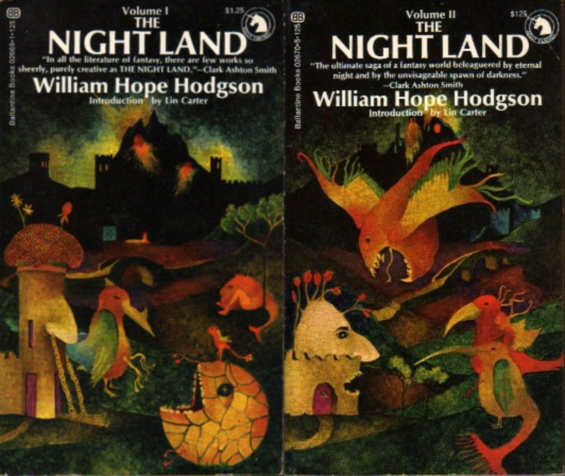
I did be most confounded, as you will understand. And truly, this time and that, as you well know if you look into your hearts, oft I did be perceived of tales great and terrible. Yet, there did be most strange and credible happenings, as you remember. -Matt’s Brain, Trying to Understand this Danged Book
Sweet mother of crap, Hodgson.
So, here’s the thing. I’m trying, generally, to write reviews for books and such that I have enjoyed. I’m trying to spread love, not hate. Why then am I bothering to write a review of a four-hundred plus page novel, written in a pseudo-archaic language, with some intense and weird misogyny, that takes easily twice as long as it needs to to say anything at all? Well, here’s the thing. There are some really, really cool and weird ideas, and this is some foundational “Dying Earth” subgenre material.
I’ve read a bunch of William Hope Hodgson’s short stories, and I’ve generally enjoyed them. This epic tale of the end of time, however, is not super fun to read. Hodgson makes a lot of very curious choices, many of which don’t work. For example, it has a framing story, or what feels like a framing story. However, after the introduction to the story, it never really features again, other than maybe a line here or there. So, it’s like half a frame, which is kind of useless. The whole tale is, apparently, a future vision of a man from the 17th(?) Century, who hopes to be reunited with his great love. Yet, once the future story starts up, the only thing that seems to connect it to the 17th Century is the language, which I guess is supposed to somehow echo a certain style. Because of the insistence of this writing style, the book becomes super repetitive and bloated, as certain phrases, like “did be,” “as you shall know,” “as you will understand,” “as you have guessed,” etc., make sequences stretch on and on. Sometimes, something as simple as “there was a pool of hot water” ends up taking him half a page to explain in the most roundabout way possible. On top of that, the story is simply not that complicated, with fewer twists and turns than any given Edgar Rice Burroughs novel. Basically, Narrator leaves home to travel out into a dark wasteland so he can save a woman he has some mystical connection to; then he finds her, and they go back to his home. There are some dangers along the way, but that’s pretty much it. More than four hundred pages for that. Add to all that, his relationship with the woman of his dreams is creepy and weird, and descends into Tarantino levels of “dainty” and “naughty” foot worship. Not to mention the physical abuse…Oy. The back half of the book is largely taken up by the narrator’s infantilization and abuse of his “true love.”
If I had a negative feeling about it, why am I writing this review? Well, here’s the thing. The book also has a lot of really cool stuff. At least, the first half does. The setting is an early example of the Dying Earth subgenre of Science Fiction. It takes place in a dark world, far, far in the future, after the Sun itself has gone out. Humanity survives in a giant pyramid called the Great Redoubt, a sort of megalopolis arcology, seemingly built on what was the ocean floor, but is now a vast desert. When the narrator goes out into the world, it is a marvelously creative and strange world, with lots of implied strangeness. You can see its influence on Jack Vance’s Dying Earth as well as Gene Wolfe’s New Sun, and others. Especially while reading the early part of his adventures out into the Night Land, I couldn’t help but think this would be another great setting for a tabletop roleplaying game. It has all the elements you might want. Even the quest for the Lesser Redoubt, a lost and forgotten secondary home for humans, has the makings of a good game campaign idea.
Hodgson produced an abridged version of the story called The Dream of X, which was apparently done for legal reasons and not artistic. Still, I wonder if it might be a more enjoyable read. I believe it’s much, much, much shorter, which seems like it could be a big improvement. I’m also interested in checking out James Stoddard’s The Night Land: A Story Retold, where he essentially re-writes the book for a more contemporary audience. I gather he names the narrator, uses dialog, and adds a few scenes. Again, the story is cool, but it’s not especially pleasant or readable.
I can’t recommend the book, unless you are looking to get some ideas for a game or if you’re just really into Dying Earth stories. Even then, almost all of the good stuff is in the first half. The giant slug fight in the second half might be about the only really cool thing that happens after the midpoint. I would love to see a tabletop RPG sourcebook that collects the lore, so I don’t have to go back and read it again, myself.
If you like what I do, you can buy me a coffee. Check out my Facebook, YouTube, or Goodreads. And take a look at my Patreon page, where I’m working on a novel and developing a tabletop RPG setting. I’m proud to be an affiliate of DriveThru RPG. I’m an independent author. You can also read my fiction over on Amazon. A rating & review would make a world of difference. I now have an Amazon Wishlist.
 Matthew J. Constantine