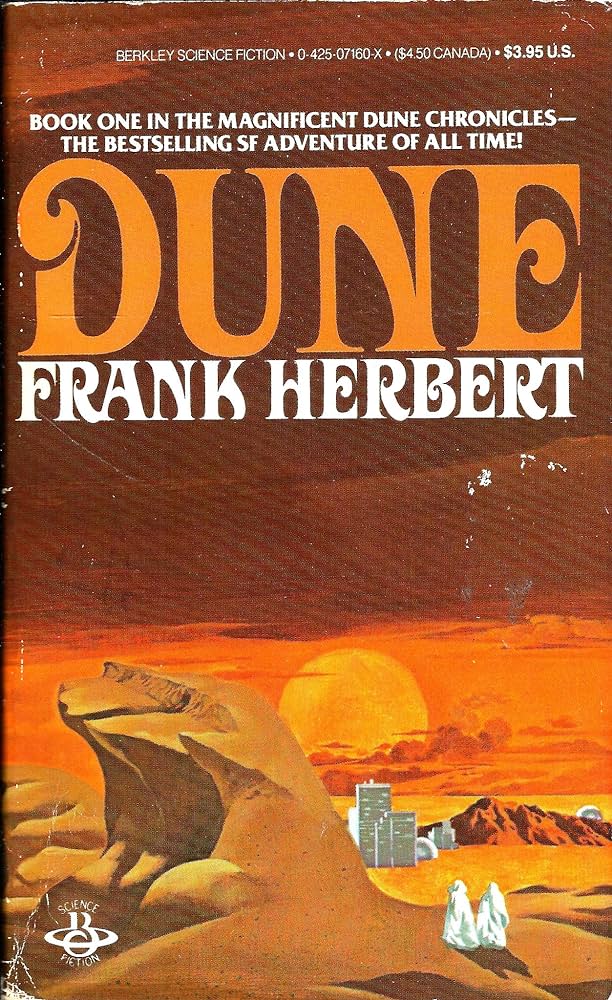
When people ask me, “what is your favorite movie?” I answer, “Casablanca.” Is that true? I don’t know. I love it. It’s a great film, and a film that I’ve revisited countless times since seeing it for the first time when I was maybe 10 years old. I’ve found new meaning in it, as I’ve come to understand Old Hollywood, as I’ve experienced love and loss, as I learned about the history within which the film was created, etc. But I love movies, and at any given time, any of a couple hundred films might be my favorite. While I’m re-watching 2018’s Mandy, for example, it’s probably my favorite movie. Same if I’m watching 1996’s The English Patient. In the same spirit, Frank Herbert’s Dune is my favorite novel. A nice, simple answer to give someone if they ask, that is essentially true.
I saw the David Lynch film adaptation when I was a kid. I really enjoyed it for its totally unhinged design and over the top characters. I heard all through my youth that it was a bad movie, bad adaptation, and that the book was much better. I also heard a lot of people say the book was hard to read, or that the first book was the only good one, or only the first three were any good, etc. When I started working at my second job, I found myself with a real lunch break for the first time. Thirty minutes where I wasn’t “on,” where I had time to myself. I started reading novels again, something I’d largely stopped doing when I reached high school, because I didn’t have the time to focus on them, the “mental bandwidth.” I’d mostly read short stories for about five years, but I was reading novels again, and I decided to pick up Dune and find out what the deal was.
I was blown away, carried to this wild future, as big and bold and grand as anything Asimov or Niven had conceived of, as beautifully written as any (place your pinky to the side of your mouth, whilst saying it) Literature, and as thought provoking as anything I’d read to that point. Culture, religion, economics, politics, ecology, and Shakespearian high drama, all woven in with ClarkeTech, psychic powers, and transhumanism. Oh my, yes. Right into my veins. I went on to consume the rest of Herbert’s series, loving the first four and enjoying the final two, even if they left me ultimately unsatisfied. I gather Herbert had intended to truly finish the series in another book or two, but died before that could happen. I have no interest in reading the works of his son Brian and Kevin J. Anderson, as nothing about them seems to fit with Frank Herbert’s works. After all that, it became my “favorite novel.”
Over the years, I’ve recommended the books to countless people, I’ve seen the (not very good) extended cut of Lynch’s film, the Sci-Fi Channel’s not bad, if somewhat low-rent, adaptation, played the classic board game, and even checked out the new tabletop RPG. But I hadn’t reread the novel in more than twenty years. When I found out there was going to be a new adaptation, I figured I should probably finally revisit the novel. That was more than two years ago, however. I started reading it and really enjoying it, but the book is long and somewhat dense. And for the last couple years, I’ve been working from home, which means I don’t have a work commute. A commute is a great way for someone like myself, who has difficulty maintaining focus, to get some real quality reading done. I got distracted. I put the book down. The first part of Denis Villeneuve’s film adaptation came out. As with Lynch’s take and the Sci-Fi Channel version, there were things I liked and things I didn’t. It didn’t spark me picking up the book again. So it sat on my end table, under a couple other books, collecting dust. That is, until this past week.
The novel is broken into three parts. The first part features a lot of world and character building, and the moving of various chess pieces into place, laying the groundwork for the story to come. I understand why some might lose the thread while reading this part. Almost every scene is a character standing in a room, when another character walks into the room and they engage in conversation. Much of the “action” takes place elsewhere, only being reported and discussed. At no point does Herbert hold your hands. Whatever strange jargon or historic reference people make, you’ve just got to accept and push through, trusting it’ll make sense as time goes on. A large cast of characters, multiple factions, plans and conspiracies within plans and conspiracies are introduced. It’s a lot. A lot. The second part of the novel jumps ahead a bit, rearranges some circumstances and introduces some larger conflicts. Then the third part brings it all together, though with a great deal still to be explored.
On its surface, the story feels like a typical Hero’s Journey, or worse the “White Savior” cliché. A wealthy young man from another world comes to a harsh and “impoverished” world, where he becomes a hero to the “primitive” native people and leads them to freedom. Star Wars meets Dances with Wolves meets Lawrence of Arabia. But that’s not really what Herbert is doing here. Paul is not the hero. I’m reminded of the meme “The ‘You Missed the Point by Idolizing Them’ Starter Kit,” which features images of several movie and TV characters who are supposed to be villains or terrible people, but who have been latched onto, often by young men who seem to miss key ideas in the film (Tony Montana from Scarface, for example). Dune isn’t about a white savior, but about the danger of investing leaders with too much power, with perceived divinity. I enjoy reading about Paul, but Paul is not a character to look up to. Sometimes noble, sure. Sometimes willing to do the hard thing, absolutely. Yet, not a hero. I find myself wondering if the second and third novels don’t exist in part to clarify Herbert’s ideas about that. They certainly contextualize things in a more clear fashion. It’s sort of like watching a show like Succession. Sure, these people are fascinating to watch, and maybe sometimes you derive a vicarious pleasure through their successes, but at no point should you be thinking, “that’s a good person who I should look up to and emulate.” If that’s where your head is at, you’re missing the entire point of the show.
As stated above, the first half of the novel is fairly talky, and maybe a bit stiff. I keep thinking of Shakespeare, not just because of the arch conflicts, but because it’s written somewhat like a stage play. Once things get going, however, the action does pick up quite a bit, and the second half of the book moves at a fair clip. Time moves forward in leaps as Paul grows in power and importance, making allies and enemies.
The book has a sort of mythological feeling to it, similar to The Lord of the Rings, Le Morte D’Arthur, The Bible, Heart of Darkness, or the story of Robin Hood, Frankenstein, Batman or Superman. It feels like the sort of thing that might spawn (has spawned) many interpretations and reinterpretations. There are moments or sequences that might be expanded or reevaluated. What about Paul and Chani’s time in the desert, but through Chani’s eyes? A novel about Duncan’s time with the Fremen? A retelling of Dune set in the boardrooms of 21st Century tech startups? Some alternate take on the story where Feyd became the Kwisatz Haderach? Again, I think of Shakespeare, and how we’ve seen things like Richard III reimagined as the rise of fascism and World War II, or something like Scotland, PA, which sets Macbeth in a burger joint. I’m not arguing that it should happen, only that I could imagine it happening. That’s the feel reading the novel gives, as though you’re tapping into some collective human mythology.
Will I continue to recommend it? Yeah. It’s not an easy read. Certainly, my second go at it took me a long time, and sometimes felt like a slog. Yet, I still found it captivating. The universe Herbert created is compelling to say the least. And the issues he wrestles with are issues we continue to wrestle with both personally, nationally, and as a species. Questionable people made into godheads and revered with cultic intensity. Religion and politics blending and being used to manipulate peope and nations, and justify atrocity. Ecological disasters. Technological ethics. Greed and avarice, as well as love and self-sacrifice. It’s a lot to take in. But I’m also reminded that many years ago, my friend Sherief, who did not enjoy reading fiction at all, actually took my recommendation and read Dune and loved it. He still mostly kept to non-fiction, but at least that one time, he got why people might read fiction. It might not be for everyone, but when the book finds the right reader, it’s wonderful.
If you like what I do, you can buy me a coffee. Check out my Facebook, YouTube, or Goodreads. And take a look at my Patreon page, where I’m working on a novel and developing a tabletop RPG setting. I’m proud to be an affiliate of DriveThru RPG. I’m an independent author. You can also read my fiction over on Amazon. A rating & review would make a world of difference. I now have an Amazon Wishlist.

