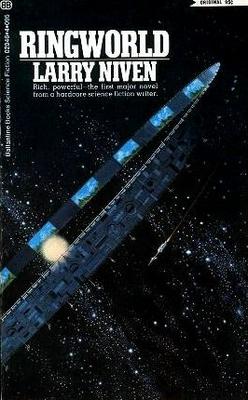
For a long time, I didn’t reread novels. I’ve always been a slowish reader, and thanks to the used book store that was near where I grew up, I had an absolute ton of books to read, so I felt guilty about the very idea of rereading something. That said, I have revisited a few over the years. After getting a copy of the long out of print Ringworld RPG (thanks Mike!) a couple years back, I wanted to dive back into Larry Niven’s Known Space. I started by going back to Protector, which I think I liked more the second time around. I finished that off and went right into Ringworld. But I put Ringworld down for some reason and more than a year later, finally picked it up and finished it. Unfortunately, my experience was sort of the opposite of when I read Protector. When I read Ringworld as a teen in the 90s, I was blown away by the huge ideas, the sense of scale, the implied deep time, etc. While all of that is still present, so are things I’d either missed or ignored.
The book came out in 1970, part of what I guess would now be considered the Hard Science Fiction boom that ran parallel to the New Wave. I’m not a scholar, so I really don’t know the history or culture of all this. I just know that a lot of writers coming up at this time were still around in the 80s when I was starting my Sci-Fi journey, writing books that fell on the harder side of Space Opera. And Larry Niven was right in the middle of it. The book is packed with ideas. The core concept of the Ringworld itself is pretty wild. A play on the proposed Dyson Sphere, this is reined back to simply (!) be a relatively narrow band around a star. The enormity of the object is well presented, even if we don’t get to see much of it. Elements from other Known Space stories are woven in, but you don’t need to have read those to follow along. For a reader like myself, who is fascinated by technology, lost civilizations, exploration, and that sort of thing, this book has a lot to offer.
Unfortunately, it is also very much “of its time.” It’s been a long time since I first read through Ringworld, The Ringworld Engineers, and The Ringworld Throne. In my memory, as the series progressed, Niven worked in what I guess were some of his ideas on sex, his kinks, or something. Part of why the third book had been a bit of a slog for me, and I think maybe have been the last Niven book I read until picking Protector up again, was how much time it spent on weird, but also super boring and pointless, stuff about sex. Don’t get me wrong. I’m not a prude. I’m all for sex. I don’t even mind some of the weirder sex in the books. It’s just that Niven handles it all so poorly, talking about it constantly, while never exploring it with any depth or nuance. What I didn’t remember is that this wasn’t something that came into the books at a later point. It’s in the first novel. Perhaps not to the same level, but it’s here, and it stands out. Sex keeps happening in the book, but it’s so soulless and nonchalant, while also being thick with mid-20th Century misogyny that it quickly becomes annoying.
This isn’t helped by one of Niven’s major failings as a writer. The characters aren’t interesting. I can usually remember Louis Wu’s name. Other than Gil Hamilton, whose name is in the title of the book, The Long ARM of Gil Hamilton, I believe Louis Wu is the only character in Niven’s entire body of work whose name I remember. His personality? Who Wu really is? Not so much. He’s a guy. He’s old, but that doesn’t matter because of anti-aging drugs. He’s moderately clever. He’s done a bunch of stuff. He’s got backward views on women. I think maybe he was rich in some vague way. Who is Teela? She’s The Woman. Very late in the book, there are a few interesting twists with her, but they’re not that interesting. Who is Speaker to Animals? He’s The Alien. He’s Worf, D’Argo, or whatever big, surly alien you want to think of. Who is Nessus? There are a lot of interesting ideas kicked around about the Puppeteers, but Nessus himself is just a fixer & opportunist. Any character development is really more just Wu realizing some aspect of Puppeteer society/biology. “Ah, ha! They do X, because of Y, resulting in Z….that’s why Nessus said Thing A when he meant Thing B.” By the end of the book, I knew something of the Puppeteers, but virtually nothing about Nessus.
Reading Ringworld as a teen was a hugely important thing for me. Not only was it one of many books that blew my mind wide open, prepping me for a love of big ideas, grand scientific exploration, and the like, but it was a direct inspiration for what would become my Conquest of the Sphere setting that I’ve written many short stories and a still unfinished novel about. It’s a bit like the John Carter books by Edgar Rice Burroughs. I read them as a young person and they were like fertilizer in the garden of my imagination. But sadly, like the John Carter books, I sort of wish they existed as the memory I had of reading them, instead of the reality of the book I just read. I don’t think it’s a bad book. I am still in love with a lot of the concepts contained in it. I’m still very excited about trying to run a game of the Ringworld RPG.
After rereading Dune, Ringworld, and some others that I’ve long considered my favorite novels, I’m starting to think I should just leave things as they are and hold onto the memory of reading books I loved. Maybe I’m just too different now, and the books I loved 20, 30, or 40 years ago won’t speak to me anymore. I know some folks reread favorites over and over, and maybe if I’d done that, the changes in me would have been gradual enough that they wouldn’t be so obvious. But 35 years is a log of water under the bridge, and I’m just not the person I was then. Honestly, I’m not sure I’d even recommend this book to someone looking for “big idea” science fiction at this point. I think I’d be more likely to direct them to something like Consider Phlebas or Ancillary Justice.
(I’m Generally trying to keep this blog to positive reviews. I don’t like bashing stuff. I don’t enjoy it. And I am glad I read this book. It is and was hugely important to me. So much so, that I couldn’t skip writing about how I felt reading it on this go-round).
I’m an independent author, so… If you like what I do, you can buy me a coffee. Check out my YouTube, and/or take a look at my Patreon page, where I’m working on a novel and developing a tabletop RPG setting. I’m also proud to be an affiliate of DriveThru RPG.

