
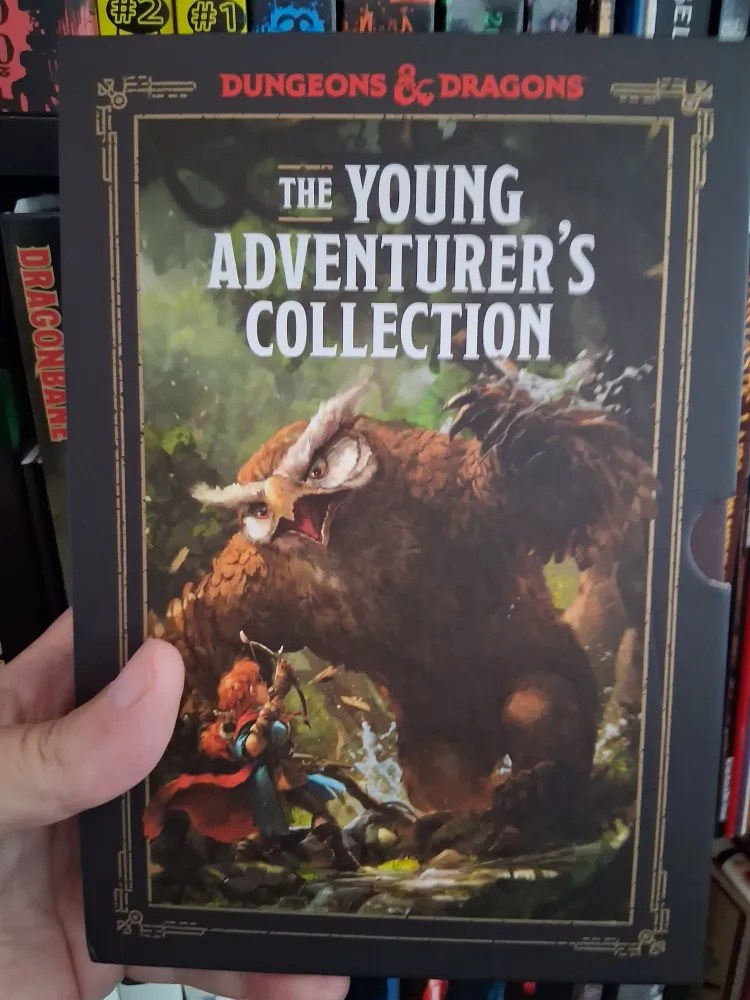
Obligatory opening for a review like this; I’m not a D&D guy. It’s never been my game of choice, and I’ve bounced off it every time I’ve had the opportunity to play, over multiple editions. So take anything said in this review with that in mind.
The Young Adventurer’s Guide series is meant as a sort of conceptual primer for young players of Dungeons & Dragons. Not a guide to rules, but to a lot of concepts within the game, like classes, magic items, creatures, dungeons, and more. There are no rules, no statistics, or math inside. You won’t step away from any of these books knowing how to play the game. My interest in the books is not really what they’re intended for, I believe, and I’ll get into that maybe at the end of this review.
Warriors & Weapons: This book looks at the “races” available to players, as well as the more physically oriented classes they might choose. After that, there’s a section on equipment. All of this seems pretty useful, especially as someone new to the game isn’t going to know what a kenku or a tiefling is. The equipment section is pretty cool, too. There are little write ups on different types of armor and weapons, but also tools of the “adventuring craft,” which aren’t necessarily things that the average contemporary person knows about. Do you use pitons or a tinder box in your daily life? Does your average 12 year old?
Wizards & Spells: Here we have the various magical classes, along with a collection of spell descriptions. This is followed up by a bunch of magical items and tools your players might use or encounter. The equipment described here is even more unusual, as most of it is made up in the first place (magic wands and such). The book also breaks down the difference between arcane magic and divine magic, which is typically pretty important in D&D style games.
Monsters & Creatures: The title pretty much sums this one up. It contains write-ups about a whole bunch of classic D&D monsters. Entries cover special powers, lairs, and general descriptions. Something I really like is that each monster has a little note for the player of what to do when you encounter one, and what not to do.
Dungeons & Tombs: This is probably the most ill conceived of the books. There’s very little material on the theory and practice of creating dungeons and tombs, exploring them, or any of that. There’s a bit about mapping and such, but not much. Most of the book is taken up by write-ups on various dungeons from adventures, like the classic Temple of Elemental Evil, or on creature write-ups, just like the ones in Monsters & Creatures. In theory, dungeon delving is a core aspect of the game, and I don’t think this book does much of anything to explore or explain what it is or how and why one might do it. What should have been the essential book in this collection turns out to feel like an afterthought.
Overall, I found this collection to be an odd beast. I picked it up for a few reasons, but mostly was hoping that the ideas contained within would be broadly applicable to Fantasy RPGs. It is more tied to D&D and more specifically to D&D 5e, than I would have liked. Some information will translate to Dungeon Crawl Classics or ShadowDark or whatever similar game I might use. But not as much as I’d hoped. There’s also a bit of an identity crisis. Are these books meant for players or dungeon masters? Seemingly both, but in being for both, they’re sort of for neither. There’s a lot of info that someone interested in being a player might want to know. But there’s a lot of info that a DM might not want players to know, and it’s all jumbled together.
To the reason I wanted to pick these up. At the time I grabbed the collection, I was expecting to start running a game (likely ShadowDark) for some younger folks I know. They’ve played a bit of D&D, but not much. I was thinking that I might take bits of the books and re-work them into hand-outs and in-world props for the players to have and read to give them ideas on how to be better adventurers. I still think that might work, but it’s going to take some work. For example, the art, which is fine, feels far too modern and polished for an in-world prop. I’ve thought about creating handouts using some of the line drawings from the old Monster Manual books, and then adding the “what to do” and “what not to do” advice from this set. The sections on equipment could be very useful. I think having a good handle on the objects a player character carries allows for more creative use of those objects in game. It certainly helped that I found this collection for less than half of its $34.99 USD list price. Especially since I mistakenly believed the books were hardcover, and they’re not.
I think the usefulness of these books is going to vary wildly. But I also think back to when I was a kid and was just getting into RPGs. I picked up The Art of the Dragonlance Saga and poured over it. I didn’t know the rules. I’d never played D&D, I hadn’t yet read any of the Dragonlance novels (though I was prompted to do so). But my imagination went wild. Perhaps these books will foster a similar feeling in youngsters.
I’m an independent author, so… If you like what I do, you can buy me a coffee. Check out my YouTube, and/or take a look at my Patreon page, where I’m working on a novel and developing a tabletop RPG setting. I’m also proud to be an affiliate of DriveThru RPG.

