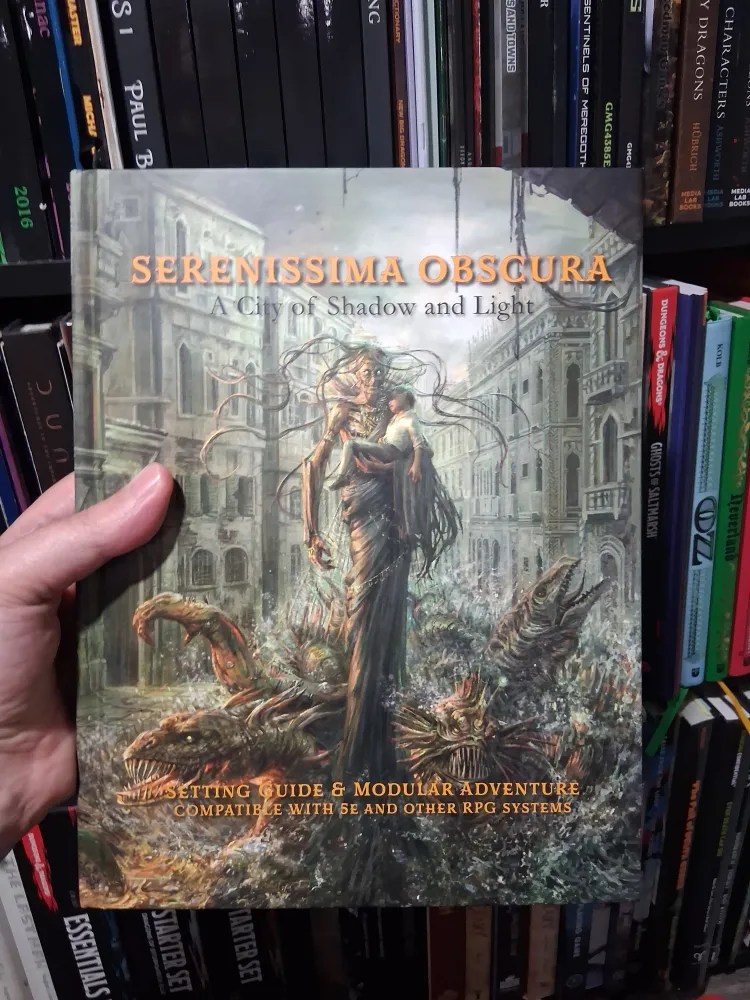
The folks at Vortex Verlag sent me a copy of this book to review. No other compensation was provided.
I’ll start this review out as spoiler free as I can, to give folks a general idea, before I dive into some specifics later. Though it can stand on its own, Serenissima Obscura is the follow-up to The Straight Way Lost, which I reviewed a while back (read my review here). The basic premise of the setting posits that the events of that previous campaign happened fifteen years earlier. It takes place in a fantastical version of Venice in the year 1507, in a world trying to come to terms with the revelation that magic is real and that demi-humans exist. Where The Straight Way Lost was a somewhat linear campaign (with the PCs following in the footsteps of Dante through his Divine Comedy), this is a much more open and modular adventure/campaign. It feels a bit odd to say, but by the time I was finished reading it, I was thinking of the book more as a toolbox or scaffolding to build a campaign around, or to let the PCs explore and find the story, as opposed to a more defined map.
Summing up my thoughts before I go into spoiler territory, I think it’s an excellent book, with a ton of awesome information and a wealth of cool ideas for city-based adventures in a historic/fantastic setting. Melina Sedó (check out my interview with Melina here) and the rest of the folks who worked on this have outdone themselves. While there are plenty of chances for combat, it would likely be best for players who are into roleplay, politics, investigating, and thinking their way through problems. If they’ve already played through The Straight Way Lost (not required), they should be more than capable of not being “murder hobos.” Like The Straight Way Lost, it is ostensibly for D&D 5e, but most of the content is system agnostic. There are a few new classes and species for 5e folks. And there is a separate guide available for using it with Ars Magica, as well as a 5e guide that I believe covers the mechanics stuff from The Straight Way Lost, including new classes & species introduced in that book. Serenissima Obscura seems like a very challenging adventure to run, and I think it will require a lot of work on the GM’s part, as well as buy-in from the players. But I can imagine it creating some absolutely marvelous gaming sessions and subsequent memories.
The book also features excellent art, and is generally visually pleasing. Some of it put me in mind of the new edition of Pendragon from Chaosium. Turns out I was noticing Mark Smylie’s art, as he worked on both.
I have a few quibbles. I’m not a big fan of glossy paper. I know matte paper is coming back into vogue, and it can’t happen soon enough. [Insert Grandpa Simpson shaking his fist at the clouds meme] I also don’t love print over textured background, though unlike some places I’ve seen them used (Rise of the Runelords, I’m looking at you!), the text remains readable. There were a few organizational choices that are counter to how my brain works. The chapter on “setlets” for example (essentially alternate campaign ideas) felt like it would have made more sense as an appendix, not at the end of the Setting Guide chapter. Again, these are quibbles.
If you’re a player and think darkly fantastical happenings in Renaissance Venice sound interesting, send your GM this way, but maybe don’t read on.
Likely some spoilers likely, beyond this point…
I’m a sucker for urban Fantasy, and Venice is one of my favorite cities that I’ve visited (see posts about my visits here and here). So, I was pretty excited to check this book out. At more than 400 pages, it’s a daunting beast of a tome. Though the book provides a lot of opportunity for adventuring outside of its core narrative, or even ignoring it, there is a sort of plot throughline. Essentially, the story is this; Lorenzo de’Medici’s son traveled to Venice and went missing. The PCs are sent to find him. They uncover a dark secret and an oncoming doom involving cults, monsters, a shadow reflection of the city, a disgraced Doge from days past, and an ancient fairy queen who has gone mad. Will they be able to stop it? Along the way, there’s a wide array of NPCs, odd occurrences, and unrelated adventure possibilities.
It’s divided into five books, and then subdivided into chapters. The first chapter of the first book covers the setting. There’s a general overview of the world, followed in Chapter two by the specifics about what happened in the years since the events of The Straight Way Lost. While it isn’t necessary to have read, run, or played through The Straight Way Lost to use this book, it was certainly helpful for me to have read it.
The third and fourth chapters cover Venice itself, going into a general history, the Church, the government, law, and major organizations. Then it explores various neighborhoods and locations around the city, as well as the people who populate them, and what they get up to. Collectively, these four chapters serve as an excellent sourcebook for running games in this fantastical version of Venice. I came away from reading it with dozens of ideas for adventures.
Chapter five covers the “setlets.” These are ideas for alternate styles of running games set in, around, or using elements of, the rest of the book’s material. As I mentioned previously in this review, I find this section’s placement to be awkward. I like the material, and several of the setlets seem like very cool adventure and campaign seeds. But showing up before the modular adventures that are the focus of the book seems odd.
Book Two has information on character creation. This doesn’t reprint the new character material from The Straight Way Lost. You can apparently also find that in The Magical Renaissance Players Guide for 5e, which I don’t have and can’t speak to. Here, you’ll find a setting specific variation of the gnome. And there is a new species, The Children of the Lagoon. Additionally, there are a couple new classes, The Merchant and The Conneslinger. Not being a D&D guy at all, I have little to say about this chapter. The new Druid Circle sounds interesting, as does the Merchant.
Book Three is about running this adventure/campaign, with suggestions on getting the tone and mood right, balancing taking your time with fostering a sense of urgency, and other ideas. I suspect this Serenissima Obscrua will be a challenging (and rewarding) adventure to run. Frankly, I could have read piles more GMing advice. Though at some point, you’ve got to bring the thing to the table and figure it out on the day. The chances of a book like this landing in the hands of a completely inexperienced GM seem slim.
Books Four and Five make up the various modular adventures, including those that further the overall plot. Book Four covers adventures set largely in our world (or the magical version of it, anyway) and Book Five covers adventures in the mad fairy queen’s shadow Venice. Each adventure is a few pages long, featuring the general premise, important characters, connections to other modules if appropriate, various bits of lore, and some victory conditions. These are not fully mapped out adventures. Instead, they’re situations, characters, creatures, artifacts, and bits of advice on how to use them. Many of them flesh out factions or important characters. They help to build the overall tapestry of the setting. These aren’t really made to be run “out of the book” like say, a typical Dungeon Crawl Classics module. Instead, they provide enough info for a GM to build on and for the players to get intrigued.
Finally, there’s a section with NPC and monster statistics, as well as a few appendices, and setting specific character sheets. There are even a few handouts. The Call of Cthulhu keeper in me is always a sucker for handouts.
I have a lot of thoughts about this book that I’m not going to be able to put into this review. I thought The Straight Way Lost was really interesting, and that the right group would no doubt have a marvelous time playing through it. But I thought it might be a hard sell for a group of players. Following the path of Dante, through Hell, Purgatory, and finally to Paradise in order to maybe save Florence. And you’d best not cause too much trouble along the way, because most potential foes are so far beyond your ability to fight, you might as well be an ant. With Serenissima Obscura, however, there is something in this for everyone. Even some balls to the wall, massive combat scenes are at least possible (and not against literal supernatural agents of the Biblical God, so there’s a chance for victory). There are a lot of different styles of adventure. A lot of it is investigation, with Horror tones. There’s plenty of opportunity for roleplaying, with a large cast of characters from various walks of life. Heck, you could even get into trade and finance, if you were so inclined.
With many of the adventures being either unrelated to, or easy enough to remove from, the central “plot,” I can see myself running at least parts of it. I know my strengths as a GM and balancing large numbers of NPCs, their personalities, and general social and political machinations are NOT among them. So, I don’t think I’d be very good at running this as a full campaign, not without heavily modifying it to play more to my strengths. But if that sort of stuff is in your wheelhouse, I bet you could make this one heck of a campaign. Thinking about Call of Cthulhu, which may actually be the game I have the most experience running at this point, I could see leaning much harder into the investigation and into the sense of Cosmic Horror that the book flirts with. There are, after all, several cults and conspiracies, a massively powerful being lurking in the shadows, being drawn forth to consume the world. And then, there are even older things, potentially more dangerous, that hide and wait.
I suppose I should mention that the book contains some fairly mature themes and some rather grim occurrences. You’ll want to make sure that you and your table are comfortable with some elements, I’m sure. Most can be veiled, hand-waved, or ignored. A few, including how the big bad gains power, and who that tends to hurt (children), are fairly integral to the overarching plot. Not that you have to revel in it, but there’s a Dickensian bleakness that’s going to carry some weight.
What’s nice is that what you’re provided with can become something of a sandbox to play in. The modular adventures, the setlets, and the overall setting could function as much as a toolkit as a campaign, with lots of dials you can turn to increase aspects you like and decrease aspects you don’t. And heck, it wouldn’t be that difficult to sand off some details and use parts of it in whatever Fantasy world is your favorite. Surely, somewhere in Faerûn, Nehwon, or east of the Misty Vale, there is a city of islands and canals, with political maneuvering, social warfare, faded glory, and ancient secrets. Due to its nature, I can’t really estimate how long this would take to play through. In many ways, its length is up to the GM and the players. Many of the adventures might take a session or two. If you were planning to play through the story of the big bad’s rise, you still might not play every scenario. Perhaps you really push the ticking clock side of things and drive through only the essentials. Maybe that’s 5 or 10 sessions. Or, if you played more toward my speed, and you supplement what’s here with some other adventures, and extrapolate upon the ones in the book, and maybe go deeper with the shadow version of Venice, and if maybe you mix in parts of the setlets, too. Well, you could spend an awfully long time within the Serenissima.
See my unboxing and first look video here.
Visit Vortex Verlag here: https://vortex-verlag.com/
I’m an independent author, so… If you like what I do, you can buy me a coffee. Check out my YouTube, and/or take a look at my Patreon page, where I’m working on a novel and developing a tabletop RPG setting. I’m also proud to be an affiliate of DriveThru RPG.

